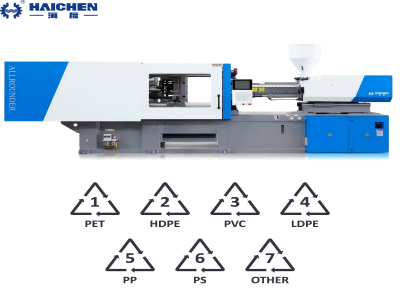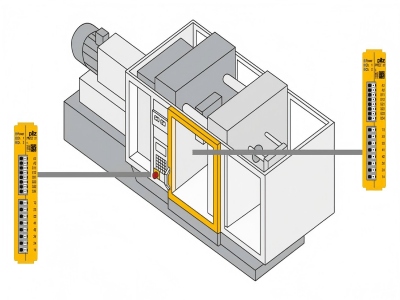
Road stud die casting machine is a type of die-casting equipment used for manufacturing road studs.
Road Spikes
A road stud is a facility used for road and traffic signs, mainly used to mark the center line,
lane demarcation line, edge line, etc. of the road to guide vehicles and pedestrians in the right direction.
According to different functions and uses, road studs can be divided into various types,
In addition, road studs can be further classified according to their material and installation method.
For example, there are road studs that are made of glass reflectors or plastic reflectors with different wear layers.
Not only are they clearly visible during the day, but they also maintain good visibility at night and in rainy weather.
Raw material selection
There are several reasons to choose to make road studs from aluminum:
Aluminum’s lightweight, high strength, corrosion resistance, compression resistance, fire resistance, antistatic,
and beautiful and durable properties make it the material of choice for making road studs.
Lightweight and high-strength
Aluminum has the characteristics of lightweight and high strength,
which makes aluminum road studs more flexible and convenient during use.
In addition, the high specific strength of aluminum, i.e. the strength of aluminum is higher at the same weight,
which is an important advantage for road studs that need to withstand a certain amount of pressure.
Corrosion and compressive resistance
Aluminum and its alloys have good corrosion resistance and compressive properties.
For example, all-aluminum road spikes can withstand pressures of up to 30 tons and can be used as speed road spikes.
This corrosion and compression resistance allows aluminum road studs to perform well in a variety of environments.
Fire and antistatic
Aluminum also has excellent fire resistance and antistatic properties,
which are important in some specific applications.
These features help improve the safety and reliability of road studs.
Beautiful and durable
Aluminum road studs have high surface hardness, do not leave handprints after touching, do not fade, and have high anti-fouling ability.
This aesthetically pleasing and durable feature allows aluminum road studs to maintain a good appearance and performance in long-term use.
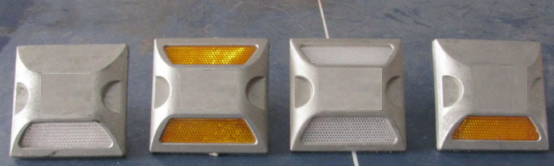
The use of road studs
Road studs have a variety of roles in road traffic, mainly including the following aspects:
Guiding direction and lanes:
Road studs can provide better visual guidance by reminding drivers to drive in their lanes through their retroreflective properties, especially at night or in rainy and foggy weather.
Warning and deceleration:
Reflective road spikes can warn drivers to slow down and slow down in curves, construction areas or other dangerous road sections.
Traffic safety:
Road studs reduce the incidence of traffic accidents by reflecting the headlights,
making it easier for drivers to notice the road edge line and ensuring that the vehicle is driving in the correct lane.
Types of road spikes
The several types of aluminum road studs mainly include the following:
All-aluminum road studs:
The shell of this kind of road studs is made of metal, which has high compressive strength and is usually used at double yellow lines.
Cast aluminum road studs:
It is divided into two types: all-cast aluminum and cast aluminum shells.
All-cast aluminum means that the shell is all made of metal with high compressive strength;
The cast aluminum shell refers to the shell is cast aluminum and the interior being filler,
which has a lower cost but low compressive strength.
Solar road studs:
This kind of road studs uses solar energy as an energy source,
which has the characteristics of environmental protection and energy saving.
Reflective Bead Studs:
These studs have reflective beads embedded in the surface to enhance their visibility at night or in low-light conditions.
The principle of reverse refraction of reflective road studs relies mainly on retroreflective materials,
which usually consist of glass beads or microprism structures with high refractive index.
When light hits these materials, the light is refracted and reflected back in the direction of the light source, i.e., back-reflection.
Each of these types of aluminum road studs has its own unique characteristics and application scenarios,
and the right type can be selected according to specific needs.
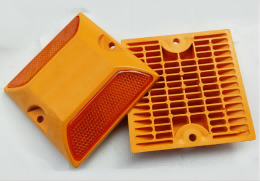
The size of the road studs
Road studs
The specifications are generally 100mm×100mm×20mm, and the height is not more than 25mm.
The specifications of reflective road studs are also usually 100mm×100mm×20mm, and the height is not more than 25mm.
Railway Road Studs
Road studs include 8mm× 80mm, 10mm× 100mm, 12mm× 120mm, 14mm× 130mm, 16mm×165mm, etc.
Other sizes include road studs with a diameter of 8 to 10 mm and a length of 30 to 75 mm.
The diameter of the spiral road nail is generally 3.0mm to 5.5mm, and the length is adjusted according to the need.
Special types of road nails
Some special types of road nails, such as doghead road nails, are specified as a nail bar length of 165mm, a cross-section of 16mm × a rectangular nail bar.
The size of the LED four-sided illuminated buried road stud is D138mm×H66mm, and the protruding ground height is only 15mm.
To sum up, the size of road studs varies according to different uses and types, mainly including road studs and railway studs, among which the specifications of railway road studs are more diverse.
The production process of aluminum road studs
The process of producing aluminum road studs with a die casting machine can be divided into the following six steps:
- Design the mould
- Make a mould
- Molten metal casting
- Injection process
- Cooling forming
- Demoulding and post-processing
Design the mould
The first step is to design an industry-standard mold that will accurately cast the required aluminum studs in the shape and size.
In mold design and manufacturing, ensuring the shape and dimensional accuracy of aluminum road nails requires comprehensive consideration and control from multiple aspects.
Design accuracy
In the mold design stage, the size and shape of the mold must be accurately predicted and calculated to ensure that the parts can meet the design requirements after machining.
Designers need to fully understand the design requirements of road studs, and ensure the stability and rigidity of the mold through reasonable mold structure design and part layout, to achieve the consistency of road nail size and shape.
High-precision measuring tools
Precise measurements must be made before mold design and machining.
Choose the appropriate measuring tools, such as micrometers, vernier calipers, etc., to ensure accuracy.
When making dimensional modifications, it is also essential to use high-precision measuring tools to ensure the accuracy of the modifications.
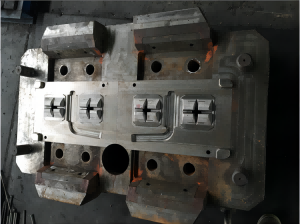
Make a mould
Process parameter control
In order to improve the accuracy and quality of road nails, designers need to continuously optimize the mold structure design,
improve manufacturing accuracy, accurately control process parameters, and strengthen the management and control of mold post-processing and correction of road nails.
Testing and correction
In the mold manufacturing process, multiple tests and corrections need to be carried out to ensure that the problems of the mold’s accuracy, durability, heat resistance, etc.
Molten metal casting
The molten aluminum is removed from the holding furnace and poured into the press chamber by a manual or automatic pouring device.
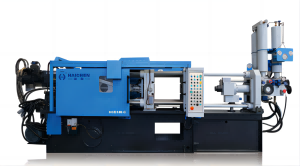
Cold chamber die casting machines work by first melting the metal in a separate crucible and then transferring the molten metal to an unheated injection chamber or injection nozzle in a certain amount.
This design can effectively prevent the metal liquid from oxidizing in contact with air, thereby improving the metal quality and production efficiency.
Injection process
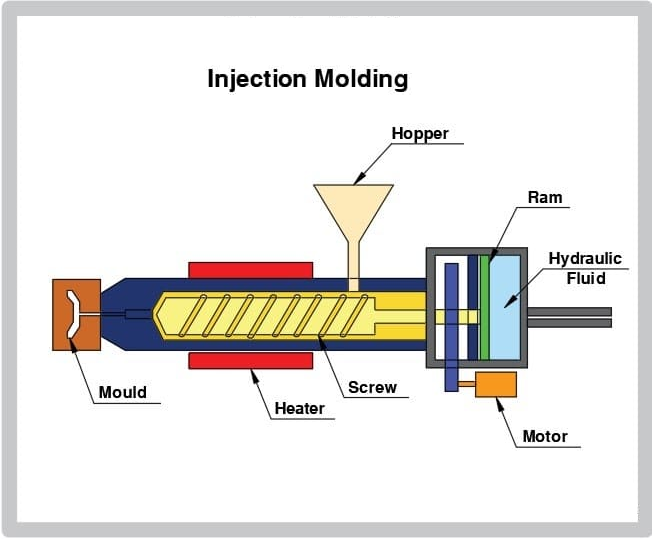
In the press chamber, the hydraulic system pushes the molten metal into the cavity of the mold through a piston.
In this process, the injection punch advances hydraulically inserts the metal into the mold cavity,
and the molten aluminum alloy is injected into the mold cavity through a concentrated inlet through high pressure.
This process requires controlled pressure and speed to ensure the aluminum alloy fills evenly into every corner.
Cooling forming
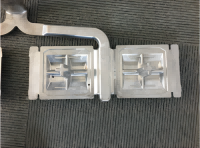
The aluminum alloy is cooled and solidified in the mold to form road studs.
The design of the cooling system is essential to improve the accuracy and quality of the product.
This process requires tight temperature and time control to ensure the density and strength of the casting.
Demoulding and post-processing
Road stud castings, after cooling, are molded to remove excess material and cleaned and trimmed.
The castings are then subjected to further heat treatment or other surface treatment processes to improve their performance and appearance quality.
Throughout the production process, strict quality control is required, including the detection and monitoring of raw materials, molds, process parameters, etc., to ensure the quality and consistency of the final product.
Die Casting Machine
Features of Road stud die casting machine
The cold chamber die casting machine has a variety of characteristics and scope of application, as follows:
Wide range of applicable materials:
The cold chamber die casting machine can be used for die-casting of zinc, aluminum, magnesium, copper, and other metals.
In addition, it can also be used for metals with high melting points such as aluminum alloys, magnesium alloys, and copper alloys.
High production efficiency:
The cold chamber die casting machine has high production efficiency in the production process and can quickly complete the die casting operation.
For example, Haichen’s horizontal cold chamber die casting machine can die cast 600 to 700 times every eight hours.
The structural design is reasonable:
The press chamber of the vertical cold chamber die-casting machine is placed vertically, and the mold is quickly filled by gravity after the molten metal is poured.
The horizontal cold chamber die casting machine does not immerse the injection chamber and the injection punch in the molten metal, and pushes the metal into the mold through the hydraulic system.
Strong flexibility:
The cold chamber die casting machine can cast products of various shapes by changing the mold, and different molds can be used at the same time, making the production process more flexible.
Wide range of applications:
Due to their high efficiency and stable characteristics, cold chamber die casting machines are widely used in automotive, aerospace, electronics home appliances, and other fields.
Why use a cold chamber die casting machine to produce road studs
There are several reasons for choosing to use a cold chamber die casting machine to produce aluminum road nails:
High precision and surface quality:
The castings manufactured by the cold chamber die casting machine have high dimensional accuracy and surface quality.
Due to the high-pressure injection and slower cooling rate, the castings produced by the cold chamber die casting machine have smooth surfaces, clear details, and high dimensional accuracy of thin-walled castings.
Excellent mechanical properties:
The cold chamber die casting machine will form a fine grain structure in the process of rapid solidification of the metal, which makes the mechanical properties of the casting better, and the strength and hardness are higher.
Suitable for high melting point metals:
Aluminum is a high melting point metal, and cold chamber die casting machines are an ideal choice.
Cold chamber die casting machines can liquefy metal at extremely high temperatures.
High production efficiency:
The production process of the cold chamber die-casting machine is simple, the efficiency is high, the operation is stable, and it is suitable for large-scale production.
Process stability:
Thanks to a special heating and holding system, the cold chamber die casting machine can better control the temperature and flow state of the metal liquid, resulting in higher-quality castings.
The cold chamber die casting machine can provide high quality, high precision, and stable castings in the production of aluminum road nails, and at the same time has high production efficiency and applicability.
It is an ideal choice for the production of aluminum road nails.
How to choose a Road stud die casting machine?
For 100*100*20 mm size studs with a cold chamber die casting machine, there are several key factors to consider:
Clamping force of the die casting machine:
Depending on the size and material of the studs, choosing the right clamping force is key.
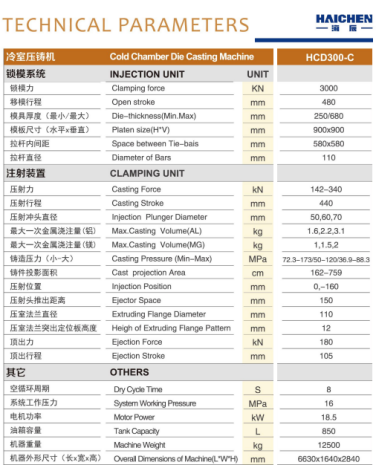
For example, the 300-ton horizontal cold chamber die casting machine of Hichain HCD-C has a clamping force of 3000kN, which can meet the production needs of most small aluminum parts.
The size of the die-casting formwork:
The size of the road stud is 100mmX100mmX20mm, so you need to choose a die-casting template that can accommodate these sizes.
The template size of the 300-ton horizontal cold chamber die-casting machine of HCD-C type is 900×900mm, which is enough to cope with the production of 2-cavity road spikes.
Ejection force and pressure increase:
For lightweight materials such as aluminum road studs, excessive ejection force, and pressure increase are usually not required.
The 300-ton horizontal cold chamber die-casting machine of Haichen HCD-C type has a pressure range of 142-340kN, which is suitable for the production of small and medium-sized non-ferrous alloy castings.
Other technical parameters:
Other technical parameters also need to be considered.
For example, the spacing between the tie rods of the 300-ton horizontal cold chamber die casting machine of HCD-C type HCD-C is 580×580mm, and these parameters also need to meet the needs of actual production.
To sum up, it is recommended to use a 300-ton horizontal cold chamber die casting machine or a similar specification machine to produce 100*100*20 mm size, two cavity aluminum road studs.
This machine not only has sufficient clamping force and injection force but also its template size and other technical parameters can meet the needs of road stud production.
The price of the Road stud die casting machine
Cold Die Casting Machine Price
The price of cold chamber die casting machines will also vary depending on a variety of factors, mainly including the following:
Cost factor
Cold chamber die casting machines are more complex and require additional steps to be performed to handle materials.
Such as aluminum and magnesium, which makes them more expensive to manufacture.
Market competition
The competitive landscape in the market will also affect the price of cold chamber die casting machines.
If there are more suppliers in the market, it may lead to price competition, which will reduce the cost.
Technical factors
The sophistication of the technology and the specifications of the product will also have an impact on the price.
High-end, sophisticated technology and high-spec products are usually more expensive.
Policy environment
Industry policies and regulatory regimes can also have an impact on prices.
For example, government support or restrictions on certain industries may cause price fluctuations.
Economic environment
Changes in the macroeconomic environment, such as inflation rate, exchange rate, etc.,
will also affect the price of cold chamber die casting machines.
Supply and demand
Market demand and supply conditions are important factors in determining prices.
If the market demand is high and the supply is insufficient, the price may rise, if there is an oversupply and insufficient demand.
Aluminum Road Studs Mould Price
The die-casting mold price of road studs not only includes material costs but also design fees,
processing fees, profits, value-added tax, mold trial fees, packaging and transportation costs, etc.
According to different needs and material selections,
the price of molds can range from tens of thousands of yuan to hundreds of thousands of yuan.
For example, the price of aluminum alloy die-casting molds is generally more than 20,000 yuan,
but it may also be as high as more than 300,000 yuan.
The price of die-casting mold for road studs mainly depends on many factors such as material cost,
design fee, processing fee, etc., and the specific quotation needs.
Precautions Road stud die casting machine
In the process of using a die-casting machine to produce road studs, the following matters need to be noted
Safety protection
Ensure that the safety guard door is always closed to prevent the occurrence of liquid metal splashing accidents,
and reduce the risk of mechanical injuries and fire accidents.
At the same time, wearing appropriate personal protective equipment,
such as hard hats, goggles, protective gloves, and wear-resistant shoes, can effectively protect operators from potential injuries.
Environmental inspection
Before starting the machine, check whether there are people or debris ensure that there is no rear before starting the machine.
Keeping your work area clean and tidy and free of clutter or other obstacles can reduce accidents and help improve operational efficiency.
Equipment inspection
Before operation, it should be checked whether the safety door switch and stop button are normal.
In addition, it is necessary to check whether the connecting fasteners of the accumulator and nitrogen cylinder are mobile and the nitrogen pressure changes to prevent any fire and heat sources from approaching.
Emergency treatment
When the machine has an emergency failure, it must be stopped immediately,
the power supply must be turned off, and emergency treatment and maintenance must be carried out.
In case of fire danger, nitrogen should be discharged from the accumulator.
Mold management
When installing and removing the die casting mold, the “manual/auto” knob should be placed in the “manual” position for adjustment.
Operating procedures
Strictly abide by the requirements of operating procedures and safety signs.
Operating procedures and safety signs usually provide information and warnings about the safe operation of the machine.
Through the above measures, the safety and stability of the die-casting machine in the process of producing road studs can be effectively guaranteed, and product quality and production efficiency can be ensured.
Road stud die casting machine Conclusion
Ningbo Haichen Machinery was founded in 2005 located in Ningbo, Zhejiang, China.
HAICHEN specializes in the production and sale of hot chamber die-casting machines,
cold chamber die-casting machines, servo die casting machines, magnesium alloy die casting machines, and relative auxiliary equipment.
HAlCHEN always places more emphasis on technology and management.
Because of its ad. advanced technology, high quality, and effective management,
“HAlCHEN”‘s hot chamber, as well as cold chamber die-casting machines, have won the trust of our clients at home and abroad.
According to Haichen’s Road stud die casting machine.
Aluminum Road Stud molds exported to the Saudi Arabian market require SABER certification.
This year only need the SCOC certification
If you want to know details for SABER certification, please visit our website of How to get a saber certificate.
Therefore, road studs exported to Saudi Arabia need to be SABER certified to ensure that the products meet Saudi standards and specifications.
Any friend who is interested in die-casting machine or needs a quotation can contact Haichen for a quotation at any time.