The crank case is a key component in an internal combustion engine, housing the engine’s main moving parts such as the crankshaft, connecting rods and pistons. Crankcase castings are typically manufactured using the High-Pressure Die Casting process, which is capable of producing components with complex shapes and high strength. Aluminum and its alloys are among the most commonly used materials in terms of material selection.
The Aluminum Crankcase is produced by a cold chamber die casting machine. With cold-chamber die casting, aluminum metal is first heated to achieve a molten state in a separate furnace.
The molten metal is then transported to the casting machine and fed into the machine’s chamber. The machine uses a pressurized plunger to force the molten metal into the engine crankcase mold cavity.
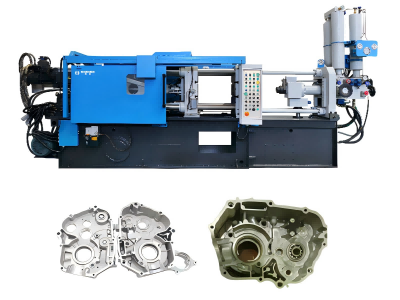
In this article, we will introduce in detail what the crankcase is, how to produce an engine crankcase, how to select the cold chamber die casting machine, crankcase die casting machine, and mold price.
What is a crankcase?
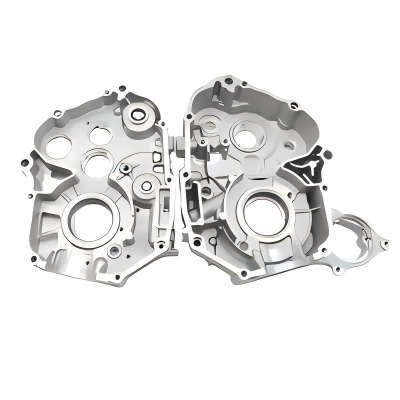
The crankcase is a key component in an internal combustion engine, its main function is to provide an enclosed enclosure for the internal components of the engine. It is usually made of metal and has holes drilled into it to accommodate components such as the crankshaft, pistons, cylinders, and connecting rods.
Construction and parts of crankcase
Upper crankcase: The upper crankcase is the upper part of the crankcase assembly. It houses the camshaft and valve train, and has holes for the intake manifold and exhaust manifold, in which the valves and valve plates are located.
Camshaft: The camshaft is connected to the crankshaft by a belt or chain drive.
Lower crankcase: The lower crankcase is bolted directly to the engine block. It is the foundation of the engine crankshaft, providing support while being continuously lubricated and cooled by circulating oil.
Crankshaft mounting: Thrust bearings ensure that the crankshaft is held in place and prevent movement. One end of the crankshaft bears its weight, distributing the oil as it rotates inside the crankcase.
Valve: It is located at the bottom of the crankcase. The function of the valve is to drain the oil, and when opened, it can promote the flow of the oil, so that the oil can be discharged under the action of gravity.
Types of crankcase
Dry crankcase: A dry crankcase is an engine design working in an enclosed space completely independent of the engine’s lubrication system. Dry crankcases are commonly found in many modern car engines and offer advantages in terms of oil control and reduced internal friction.
Wet crankcase: Unlike a dry crankcase, a wet crankcase is where oil is injected directly into the crankcase housing. The crankshaft, connecting rods, and other moving parts are partially submerged in oil, providing continuous lubrication and cooling. This design is commonly found in two-stroke engines, small gasoline engines, and some older car engines.
Semi-wet crankcase: Semi-wet crankcase is available in both dry and wet designs. The crankshaft and connecting rod are partially immersed in an oil reservoir. Semi-wet crankcases are found in a variety of engines, with the advantages of both wet and dry designs.
Besides these types of crankcases, there are other types, such as closed crankcases and open crankcases.
The function of the crankcase
The primary functions of the crankcase include supporting critical components, withstanding shock and inertia forces, storing and managing lubricating oil, and providing easy access for maintenance and inspection.
Together, these functions ensure proper engine operation and long-term stability.
How is a crankcase manufactured?
- Design the crankcase mould
- Prepare the metal material
- Molten metal
- Casting process
- Cooling
- Reprocessing
Design the crankcase mould
At first, the initial step in the die casting process is creating a mould. This mould is usually made from steel or aluminum and is designed to withstand the high temperatures and pressures of the die casting process.
The mould design begins with developing a CAD design of the required crankcase mould. This design is then used to create a crankcase mould by CNC machining, which is further used in the casting process.
Prepare the metal material
The next step is to prepare the metal for injection. The crankcase is mainly made of aluminum alloy material. The aluminum metal is melted in a furnace and then poured into a ladle.
Molten metal
The pouring of molten aluminum metal from an external melting vessel into an unheated pressurized or cold chamber. This step can be done manually, mechanically, or by pumping.
Casting process
Stage 1: The hydraulically operated plunger pushes the liquid metal to fill the front of the press chamber and accumulate at the front of the inner gate. This phase allows sufficient time for the air in the press chamber to escape and prevents the liquid metal.
Stage 2: The plunger pushes the liquid metal at high speed into the crankcase mold cavity, where it is cooled and solidified while maintaining a certain pressure to obtain the finished crankcase product.
Cooling
Inside the crankcase mold, the aluminum metal is rapidly cooled and solidified under high pressure. When the metal is fully cured, the crankcase mold opens and the finished crankcase product is ejected and removed from the mold.
Reprocessing
At last, according to the need for further processing and treatment of the finished crankcase product, such as deburring, surface treatment, etc.
About Haichen cold chamber die casting machine
Advantages of Haichen cold chamber die casting machine.
Complex shapes: Haichen cold chamber die casting is a process that can produce complex shapes with tight tolerances.
Increased strength and weight: Haichen cold chamber die castings are stronger than injection molded parts with the same dimensions. Compared to other casting methods, thin-walled castings are stronger and lighter in weight.
High accuracy: Cold chamber die casting is capable of producing parts with high dimensional accuracy and smooth surfaces.
Short production lead time: The entire cycle time for cold chamber die casting is typically only about 1 minute, which makes the process particularly suitable for application scenarios.
The short cycle time limits the amount of time the molten metal is in contact with the mold material, thus reducing the possibility of chemical reactions and improving product quality.
Wide range of material suitability: Cold chamber die casting machines are mainly used for die casting of high melting points alloys such as aluminum, magnesium, and copper, which makes them more effective in handling these materials.
Strong structural stability:
(1) Integrated platform design reduces the risk of oil leakage under high pressure.
(2) Thick plate and tight rod design ensure injection alignment is maintained during long-term operation.
How to choose a cold chamber die casting machine to produce an aluminum crankcase?
Selecting a cold chamber die casting machine suitable for producing aluminum crankcases requires consideration of several factors, including the machine’s clamping force, injection pressure, and die size and type.
First, define the size and weight of the aluminum crankcase you want to produce. This will help you determine the required clamping force.
Clamping force is critical to ensure that the mold remains tight under high pressure. For example, the 300-ton horizontal cold chamber die-casting machine of Haichen HCD-C has a clamping force of 3000kN, which can meet the production needs of most small aluminum parts.
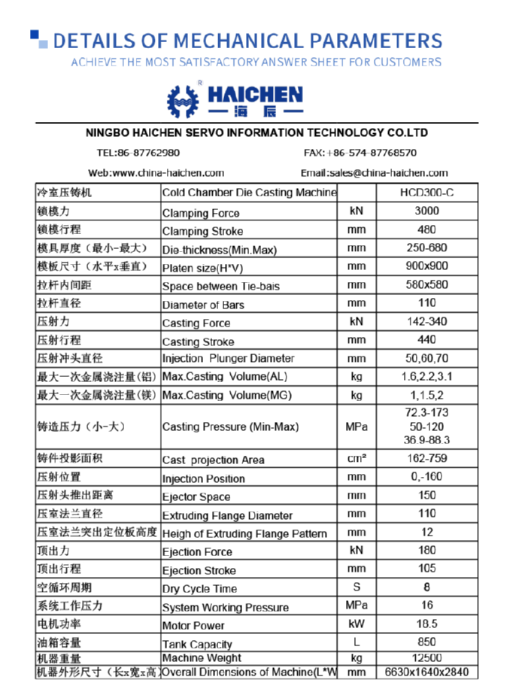
Injection pressure and speed significantly affect casting quality. High injection pressures can increase the filling rate and reduce bubbles and defects.
We can recommend the right machine for our customers based on the weight and size of their crankcase products. Modern cold chamber die-casting machines are usually equipped with auxiliary equipment, which can significantly improve production efficiency and casting quality.
About crankcase cold chamber die casting machine and mould price
Cold chamber die casting machine prices vary significantly by model and tonnage. Cold chamber die casting machines can range in price from tens of thousands of dollars to millions of dollars.
Crankcase cold chamber die casting machines price depends on the size of the crankcase mold. The cold chamber die-casting machine price for making the aluminum crankcases is according to the client’s request. We will choose a suitable machine model for clients.
Ningbo Haichen Machinery was founded in 2005 is located in Ningbo, Zhejiang, China. HAICHEN specializes in the production and sale of hot chamber die-casting machines, cold chamber die-casting machines, servo die casting machines, magnesium alloy die casting machines, and relative auxiliary equipment.
We supply machines, molds, and auxiliary equipment according to our customer’s requirements and offer customized and innovative solutions to meet their needs while providing excellent customer service and support. Welcome to visit our website for more information: haichen-machine.com