The importance of injection molding tolerances lies in ensuring precision, consistency, and quality in plastic parts.
Injection molding is a widely used method for manufacturing plastic parts in production.
Strict dimensional control throughout the production process is key to ensuring that the final product fully meets the design requirements and functions stably.
This control is indispensable because it directly determines whether the parts can be assembled accurately and reliably, while avoiding additional production costs caused by dimensional deviations
Definition and core value of tolerance
Technical definition
Tolerance refers to the acceptable fluctuation range of the size of molded parts (such as ±0.1mm). This value is used to compensate for small deviations caused by factors such as shrinkage and material flow during the manufacturing process.
- Processing tolerance: The accuracy range of the mold itself, usually controlled within ±0.076mm (±0.003 inches).
- Resin tolerance: The dimensional deviation of the finished part, this value is usually not less than ±0.051mm/inch.
Core value
- Assembly reliability: Setting inappropriate tolerances can cause problems when assembling parts. For example, a 0.5 mm deviation in hole position may prevent a bolt from being inserted.
- Cost control: Specifying a reasonable tolerance range helps reduce rework rates and avoids wasted resources caused by scrapping entire batches of parts.
- Functional reliability: In medical device manufacturing, a precision tolerance of ±0.025 mm is critical to ensure the safe operation of life-support equipment.
Tolerance grades and industry standards
Grade classification
| Grade | Applicable scenarios | Typical range (mm) |
| Normal tolerance | General parts (such as daily necessities) | ±0.1 |
| Strict tolerance | Precision assembly parts (such as electronic housings) | ±0.05 |
| Very strict | Medical/aerospace parts | ±0.025 |
Industry standards
Different industries use specific standards to regulate product tolerance requirements.
- ISO 20457 standard unifies global specifications for dimensional, geometric and surface tolerances, helping manufacturers ensure component accuracy.
- ASTM D6913 provides specific operational guidelines for part measurement and testing, guiding companies on how to perform quality control.
- In the automotive industry, the QS-9000 standard requires that the tolerance of key components must be controlled within ±0.05mm, which is crucial to ensuring driving safety.
Importance of injection molding tolerances
In the injection molding production process, precise control of part dimensions (i.e. tolerances) is essential.
Consistency and Quality
First, strict dimensional control ensures that the shape, size, and quality of each part remain highly consistent. This is especially critical – when multiple parts need to be assembled into mechanical equipment, dimensional consistency directly determines whether they can be assembled smoothly and achieve the expected function.
Reduced Waste
By precisely controlling injection molding tolerances, companies can significantly reduce the number of defective products in the production process. This means that each batch of raw materials can be more efficiently converted into qualified products, which not only reduces waste generation, but also improves overall production efficiency.
Enhanced Performance
Parts that meet dimensional standards perform more stably in actual use and have a significantly longer service life. Precise dimensional control can effectively reduce the clearance between components, thereby reducing the risk of abnormal wear and directly improving the durability of the product.
Regulatory Compliance
In fields such as medicine and aerospace, which require extremely high safety, part dimensions must strictly follow industry mandatory specifications. Accurately controlling injection molding tolerances is not only a basic prerequisite for meeting regulatory certification, but also a necessary condition for ensuring product safety.
Five key factors affecting tolerance
| Factor | Influencing mechanism | Optimization direction |
| Material shrinkage rate | Crystalline materials (such as PP) have a shrinkage rate of up to 1.5-4%, while amorphous materials (such as PC) have a shrinkage rate of only 0.7-1%. | Select low shrinkage materials (such as LCP shrinkage rate 0.02-0.05%) |
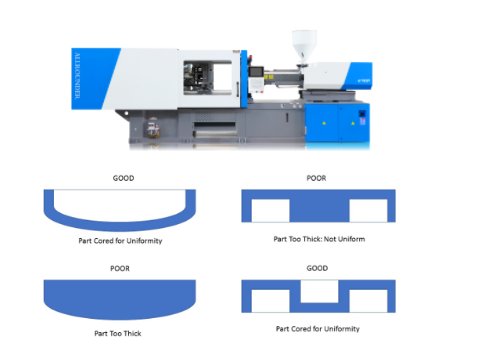
| Part design | Uneven wall thickness leads to differences in cooling speed and warping risk (for example, the shrinkage rate of the thick wall area is 30% higher than that of the thin wall area). | Uniform wall thickness + reinforcing ribs replace thickening |
| Mold process | Improper gate position causes flow imbalance and dimensional deviation | Mold flow analysis optimizes gate design |
| Injection parameters | Insufficient pressure → incomplete filling; excessive pressure → overflow deformation | Closed-loop control of pressure/temperature (±1℃ accuracy) |
| Cooling system | Uneven cooling leads to shrinkage differences (temperature difference of 5℃ can cause 0.1mm warping) | Conformal water channel design |
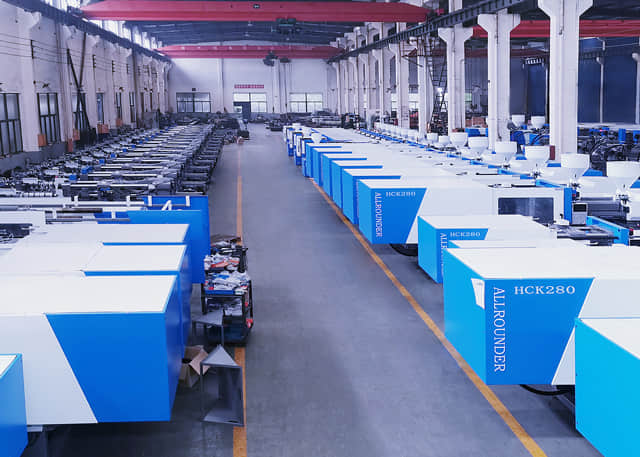
HAICHEN: A Leader in Precision Injection Molding
As a leading company in the field of injection molding machine manufacturing, HAICHEN‘s core competitiveness is reflected in precision control and technological innovation. Our equipment helps customers improve production efficiency in the following ways:
- Precision control system: Engineers have equipped each device with an intelligent control module, and operators can directly adjust key parameters such as injection speed, pressure and cooling time to ensure the accuracy requirement of ±0.01mm.
- Energy consumption optimization design: After adopting variable frequency drive technology, customers reported that the energy consumption of the equipment was reduced by about 18%, which not only saved electricity expenses but also reduced carbon emissions in the production process.
- Automation integration: From mold positioning to finished product ejection, the entire process has been automated. After a certain auto parts manufacturer in Fujian adopted this system, labor costs were reduced by 40% and the yield rate increased to 99.3%.
Injection molding tolerances are critical to get right. Tight tolerances guarantee consistent results, high quality, and reliable performance. This makes them vital for precision-demanding fields. Whether you’re working in automotive, aerospace, or medical sectors, paying close attention to tight tolerances is key to success.