Injection molding tie bar selection guide involves tie bar spacing selection, tie bar type, rigidity, and stability, etc. From tie-bar spacing, it is a boundary condition for mold design. It predominantly defines mold installation size and boundary of safe operation.
Installation of mold is impossible, equipment may sustain damage and production risks may arise if the mold’s width, height, and thickness do not comply with the tie-bar spacing. During design, safety clearance must be kept, and the balanced optimum spacing should be established for the injection molding machine’s tonnage and process requirements in terms of optimum cost with efficiency.
The tie rod spacing selection must comply with the mold size and the installation method, foremost among which is the safety clearance compliance, which must be conclusively examined with three-dimensional verification of spatial envelopes, height, and width. Eliminate risk of production interruption or equipment damages due space mismatch.
In most cases of injection molding, selection of tie bars is considered as the main contributing element in mold installation and the quality of the processing. In the next section, a comprehensive guide is provided regarding tie bar selection.
Tie Bar Spacing Selection
Function
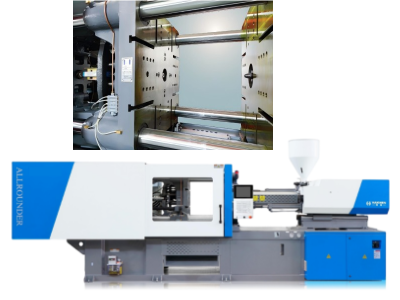
Tie Bar Spacing is an important parameter that determines the size of the mold. Tie Bar Spacing is usually determined by the distance between the horizontal and vertical tie bars of the injection molding machine. It directly affects the maximum size of the mold.
For example, the width of the mold should be less than half of the horizontal tie bar spacing. And the length should be less than half of the vertical tie bar spacing.
In addition, the size of the mold should also take into account the weight of the mold. And the installation method to avoid damage to the tie bars during installation.
Safety clearance requirements
- Small molds: Allow ≥25mm clearance on each side.
- Large molds: Allow ≥50mm clearance on each side.
This prevents the mold from colliding with tie-bars during installation, causing deformation or affecting mold plate movement.
Mold thickness matching
Mold thickness must be within the minimum/maximum mold thickness range allowed by the injection molding machine.
The Impact of Tie-Bar Spacing on Mold Design
- The mold width/height should be at least 1/2 inch (approximately 1.27 cm) wider than the cavity size to ensure structural strength.
- The mold thickness is recommended to be 2.5 times the cavity depth to ensure complete coverage when the mold is closed.
- The mold’s center of gravity must be aligned with the injection point to prevent uneven force on the tie-bars, which can cause breakage.

Selection of tie bar type
There are three main types of clamping systems for injection molding machines.
Mechanical Clamping (Toggle Clamping)
Mechanical clamping is suitable for low-tonnage machines. It uses linkages to generate clamping force but may have limited tie bar adjustability.
Hydraulic Clamping
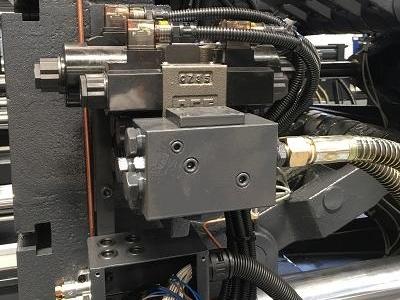
Hydraulic clampoing offers greater flexibility and higher clamping force (150–1,100 tons). Tie bars are tensioned hydraulically, allowing precise force control.
Tie Bar Free (TBF) Clamping
Tie bar free calmpiong eliminates tie bars entirely, enhancing mold area cleanliness and rigidity while reducing mold deformation. Ideal for large or complex molds
The rigidity and stability of the tie rod
The rigidity of the tie rod directly not only affects the stability of the injection molding machine. But also the processing quality of the mold. If the rigidity of the tie rod is insufficient, it may cause deformation of the mold during processing or uneven clamping force.
Therefore, when selecting a tie rod, priority should be given to tie rods with high rigidity and evenly distributed clamping force.
The Core Role of Rigidity
- The rigidity of tie rods directly impacts the stability of the injection molding machine and mold processing quality.
- Insufficient rigidity can lead to mold deformation and uneven clamping force distribution during mold closing, resulting in product defects such as flash, sink marks, or flow marks.
- Highly rigid tie rods evenly distribute clamping force, ensuring uniform mold cavity filling, which is crucial for product surface quality (e.g., consistency).
Material Selection and Strength Requirements
- Tie rods must be made of high-tensile-strength steel (such as high-carbon steel).
- Its tensile strength is far greater than that of ordinary steel and can withstand clamping forces of hundreds of tons.
Structural Design and Stability Optimization
- Spacing Limitations: The tie rod spacing determines the upper limit of mold size.
- The mold’s length and width must be smaller than the tie rod spacing. Otherwise, the mold will need to be rotated, hoisted, or replaced.
Installation and maintenance of tie rods
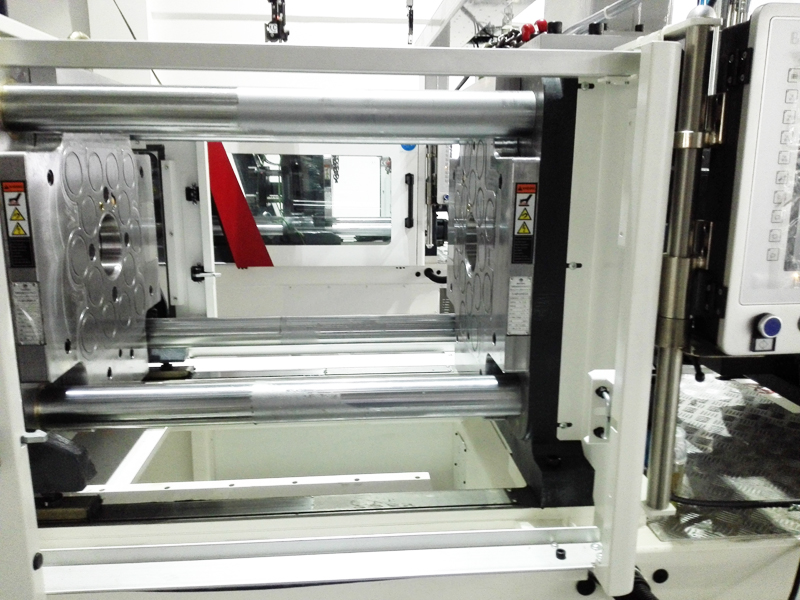
The installation of tie rods needs to ensure that their position is accurate. And that they fit well with the mold.
During installation, it should avoid heavy molds hit directly to the tie rods to avoid damage to the tie rods.
In addition, tie bar maintenance for injection molding machine: regular inspection of the elongation of the tie rods and changes in the clamping force can help optimize the injection molding process and improve product quality.
Install positioning and alignment
- Center Alignment: The mold expansion force center must be aligned with the injection molding machine clamping center, with a maximum deviation of ≤5mm, to ensure uniform force distribution across all four tie rods.
- Locking Ring Inspection: Confirm that the mold locating ring matches the locating hole size of the injection molding machine’s fixed platen.
Installation Steps
- Lubrication: Apply lubricant to the tie rod surface before installation to reduce friction loss.
- Tie Rod Insertion: Thread the tie rod through the piston and seal ring. Install the O-ring seal (4-80) into the inner and outer end grooves.
- Cylinder Installation: Tilt the lubricated cylinder (3-70) 15°–30° and slowly insert it into the piston to avoid damaging the seal.
- Torque Control: Tighten the tie rod nuts in alternating steps (100 lb-ft increments) until the final torque value is reached (refer to the equipment manual).
Visual Inspection
- Inspect the tie rods weekly for wear, corrosion, cracks, and abnormal signs of wear. Early detection can prevent downtime.
Cleaning and Lubrication
- Keep the tie rods clean and remove dust and oil regularly.
- Continuously lubricate the sliding feet, guide rails, and guide rods to extend their lifespan.
Balanced Operation Maintenance
- Pre-Startup Inspection: Confirm that the load tolerance on all four tie rods is ≤5mm. Adjust the mold support if necessary.
- Check the hydraulic oil level, screw tightness, and lubrication system.
- Avoid insufficient or excessive clamping pressure during operation to prevent tie rod overload.
The relationship between tie rod spacing and mold design
The mold design needs to take into account the limitation of tie rod spacing. For example, the width and height of the mold should be at least 1/2 inch (about 1.27 cm) wider than the cavity size to ensure sufficient structural support strength.
In addition, the thickness (Tack Height) of the mold is usually set to 2.5 times the depth of the cavity to ensure that the mold can fully cover the cavity when closed.
Choosing the right space between tie bar requires comprehensive consideration of the type of injection molding machine, the design requirements of the mold, and the specific needs of the production process. By properly selecting the tie rod spacing, type, and installation method, the quality and efficiency of injection molding can be significantly improved.
Mold Thickness and Tie-Bar Spacing
- Mold thickness (tack height) must be adapted to the tie-bar spacing of the injection molding machine. It is noted that mold thickness is typically set at 2.5 times the cavity depth to ensure complete cavity coverage during mold closing.
- Also, mold thickness must be within the minimum/maximum mold thickness range allowed by the injection molding machine; otherwise, mold closing function will be affected.
Structural Limitations and Design Optimization
- Tie-bars located at the four corners of the mold plate (referred to as “dead corners”) create physical restrictions.
- Mold design must avoid these areas, and the width/height must be within the mold plate dimensions.
- Adjusting the verticality and spacing of the tie-bars ensures mold concentricity and prevents parting surface misalignment, which is particularly important for precision molds.
Impact on Production Efficiency
- Although selecting an excessively large tie-bar spacing allows for larger molds, it also increases equipment costs.
- Excessively small spacing limits mold size flexibility and may require frequent machine changes or mold modifications.
Haichen injection molding machine space between tie bar paramter
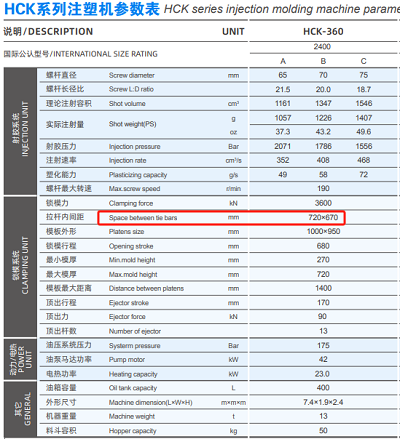
Haichen injection molding machine
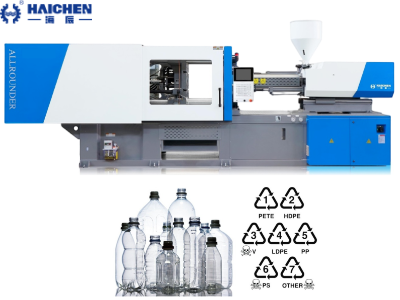
Haichen is one Chinese injection molding machine manufacturer. Our servo energy saving injection molding machines quality under CE safety standards certificated.
Haichen have rich experience of producing plastic products, with successfully cases for your reference. We can supply complete production line as per customer’s specific demand.
Consider the above. You can choose a suitable plastic injection molding machine and mold to ensure product’s quality and production efficiency.