Optimal L/D ratio for PC in injection molding generally recommends is 20:1 which can balance shear heat, mix effect and meet most standard production needs.
This range can balance the mixing uniformity of the melt, fluidity and the risk of avoiding material degradation. When making specific choices, it can adjust that according to actual production conditions (such as product thickness, shape complexity, etc.). For example, for thicker or more complex products, a higher L/D ratio (such as 20:1) may be required to ensure sufficient plasticization and uniform mixing of the melt.
Below are the comprehensive analysis of the optimal screw length to diameter ratio (L/D) value of polycarbonate (PC) material in injection molding:
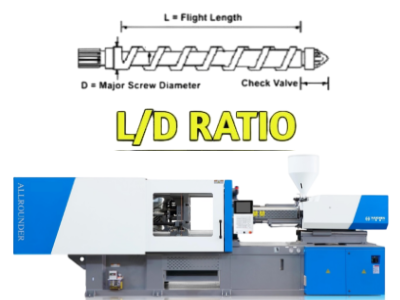
What is L/D Ratio?
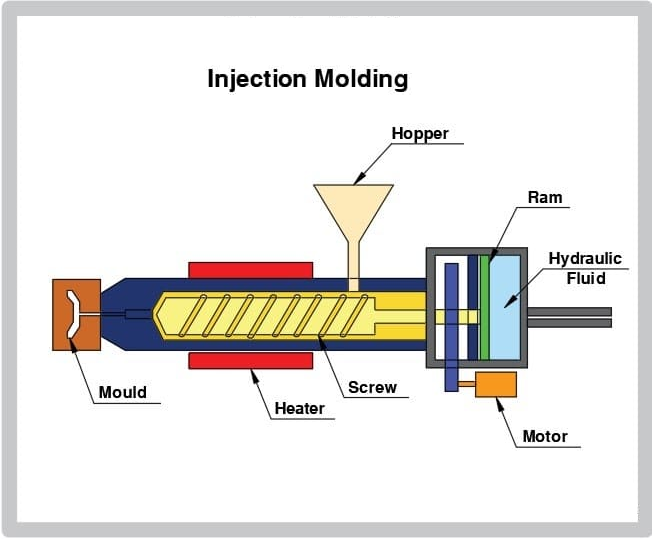
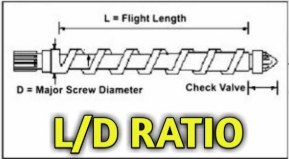
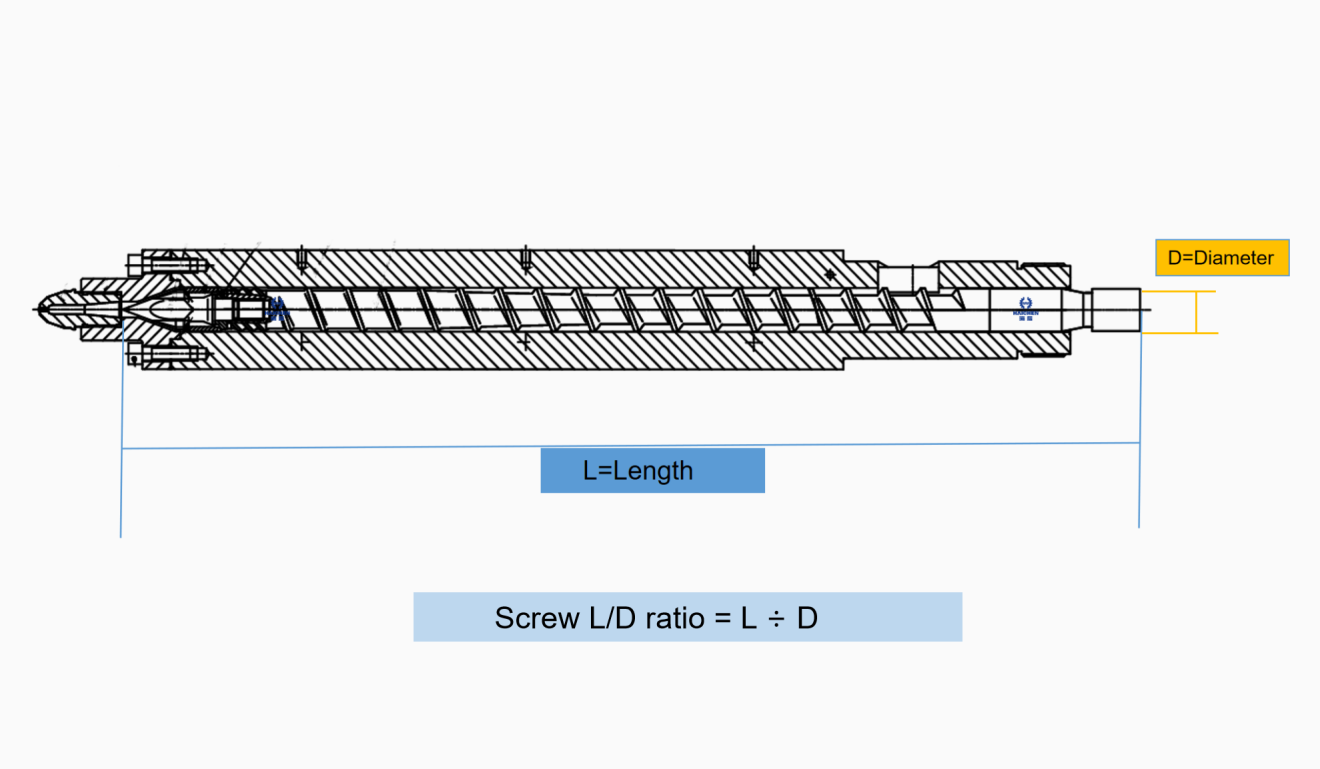
L/D ratio is the ratio of the length of injection molding screw (L) to it’s outer diameter (D).
Frankly speaking, L/D ratio is a very important parameter to a plastic injeciton molding machine. As it affects a lot on the injection machine melting performence and final plastic injection molding products quality.
Standard recommended value of optimal L/D ratio
L/D ratio of 20:1
Multiple evidences show that for polycarbonate materials, the L/D ratio of the injection molding machine screw is generally recommended to be 20:1.
For example, it clearly states that the Indian standard recommends using an L/D ratio of 20:1 for processing polycarbonate.
For PC materials with high thermal stability and high viscosity. It recommends that a screw with an L/D ratio greater than 20:1 and at least 15:1, which indicates that a longer and thinner screw is more ideal.
L/D ration between 15:20
The screw L/D ratio of PC materials is usually between 15:20.
For injection molding machine screws processing polycarbonate, the recommended L/D ratio is 20:1
The L/D ratio of injection molding machine screws is usually between 16:1 and 20:1, which further supports the above range.
For injection molding of PC materials, the standard recommended L/D ratio range is 15: 1 to 20: 1. This range can ensure good melting performance and product quality while avoiding problems such as thermal degradation or uneven flow caused by improper screw design.
Other applicable ranges of L/D ration
Regarding the optimal screw length to diameter ratio (L/D) range for polycarbonate (PC) in injection molding, the evidence does not directly mention the optimal L/D ratio of PC materials.
L/D ration 18:1 to 20:1
However, it can learn that from the L/D ratio of injection molding machines is usually in the range of 18:1 to 20:1, which is suitable for a variety of thermoplastics, including PC.
In addition, a higher L/D ratio contributes to more uniform shear heat generation and better mixing, thereby achieving a more uniform melt quality.
L/D ration 16:1 and 20:1
Although 20:1 is a common recommended value. Some literature mentions that the L/D ratio may adjust according to specific needs.
For example, it points out that the L/D ratio usually use between 16:1 and 20:1. While and mention that the L/D ratio may reach 20:30 in some cases. However, these higher ratios are usually suitable for specific process requirements or material properties.
Influence factors of optimal L/D ratio for PC materials in injection molding
- Effect of L/D ratio on melt quality
- Influence of material properties on L/D ratio
- Synergy of injection molding process parameters
The choice of L/D ratio directly affects the shear heat of the melt. And the mixing effect, and the residence time of the plastic in the screw. A larger L/D ratio (such as 20:1 and above) can provide more shear heat, thereby improving the uniformity of the melt, while extending the residence time for better mixing. However, too high an L/D ratio may lead to increased energy consumption and complicated equipment design.
Effect of L/D ratio on melt quality
It mentions that if using a general-purpose screw, a minimum L/D ratio of 26:1 recommends to avoid melt quality problems caused by low L/D ratio.
Such as resin decomposition, burning, and color change. In addition, a lower L/D ratio may require increasing the barrier area of the screw section or using a larger press to produce high-quality melt.
Influence of material properties on L/D ratio
PC is a heat-sensitive engineering plastic with good mechanical properties but poor fluidity.
Therefore, during the injection molding process, special attention needs to be paid to temperature control and screw design.
The melt temperature of PC is generally between 270°C and 320°C. And the choice of L/D ratio directly affects the fluidity and shear uniformity of the melt.
Synergy of injection molding process parameters
Other parameters in the injection molding process (such as injection speed, holding pressure, cooling time, etc.) can also affect the effect of the L/D ratio.
For example, higher injection speeds and holding pressures may improve the fluidity of the melt, allowing the use of a lower L/D ratio.
However, changes in these parameters may also have a negative impact on the quality of the final product, so comprehensive consideration is needed.
Considerations in practical applications
In actual production, it should combine the selection of L/D ration with mold design, injection pressure, cooling time and other factors. For example, it mentiones that if the screw design is improper or the L/D ratio is too small, it may lead to a shortened molding cycle or reduced product quality. Therefore, when selecting the L/D ratio, it is necessary to comprehensively consider material properties, equipment capabilities and production goals.
General Recommendations:
For PC injection molding, a screw L/D ratio of 15:1 to 20:1 and a compression ratio (C/R) of 2-3 are generally recommended to balance plasticizing efficiency and energy consumption.
The minimum L/D ratio should not be less than 16:1, with an optimal range of 18:1 to 24:1 to improve melt uniformity and low-temperature plasticizing capability.
Material Properties and Flowability
PC has poor flowability. High melt index (MFR) grades (>25g/10min) improve filling properties and are suitable for thin-walled parts.
Matching Equipment and Process
- Injection Volume Limit: The total injection volume (including runners) must not exceed 70–80% of the injection molding machine’s rated injection volume to avoid insufficient plasticization.
- Screw Design: A tapered compression screw with a check ring must be used. If producing flame-retardant PC or alloy materials, a corrosion-resistant design is required.
- Clamping Force Calculation: 0.47–0.78 tons/square centimeter x the projected area of the product should be used to prevent flash.
Mold and Temperature Control
The mold temperature should be maintained between 80–130°C (80–100°C for pure PC and 100–130°C for glass-fiber-reinforced PC). Uniform temperature control can reduce warping and stress cracking.
The gate should be located at the thickest point of the wall and be sufficiently large (with a depth of 70% of the wall thickness) to minimize shear defects. Pin-shaped, ring-shaped, or rectangular gates are recommended.
Other related parameters
In addition to the L/D ratio, the compression ratio (usually between 1.5:1 and 2.5:1) is also an important parameter affecting PC injection molding.
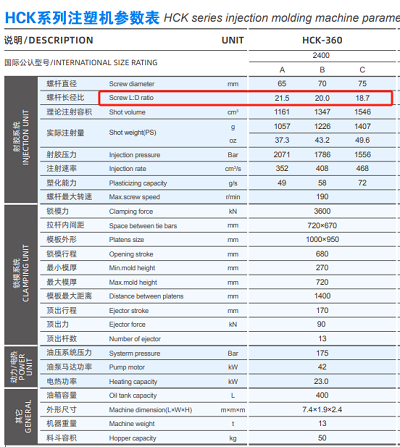
In addition, the mentioned L/D ratio range of different types of injection molding machines (such as 18.7:1 to 24:1) , which indicate that different equipment manufacturers may provide different optimization solutions.
Screw Design
- Compression Ratio (C/R): Recommended 2:1 to 3:1.
- Screw Type: Single-start, equidistant-pitch, progressive compression screw with check ring.
- Speed: 40-70 RPM, adjustable depending on screw design.
Temperature Control
Melt Temperature
- PC/ABS Material: 260°C
- Pure PC: Avoid overheating and degradation. The specific temperature should be adjusted based on the product size
Based on the information I have searched, the optimal screw length to diameter ratio (L/D) for injection molding of polycarbonate materials generally recommends to be 20:1. This ratio can balance shear heat, mixing effect and energy consumption, while meeting most standard production requirements. However, in special cases, it can be appropriately adjusted to a higher ratio (such as 20:30) according to specific process requirements, but its impact on energy consumption and equipment complexity must be weighed.
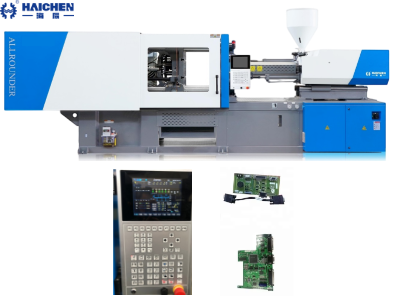
Haichen injection molding machine
Haichen is one Chinese injection molding machine manufacturer. Our servo energy saving injection molding machines quality under CE safety standards certificated.
Haichen have rich experience of producing plastic products, with successfully cases for your reference. We can supply complete production line as per customer’s specific demand.
Consider the above. You can choose a suitable plastic injection molding machine and mold to ensure product’s quality and production efficiency.