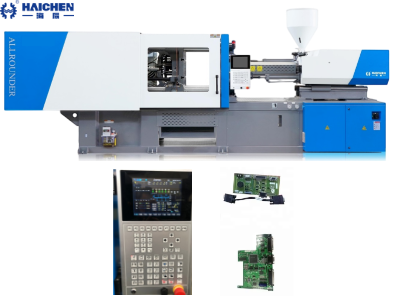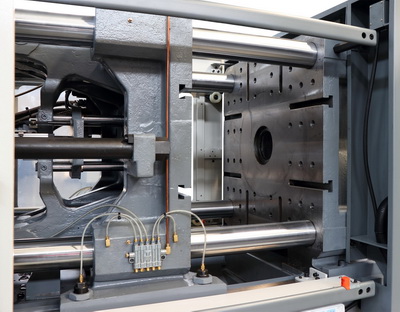
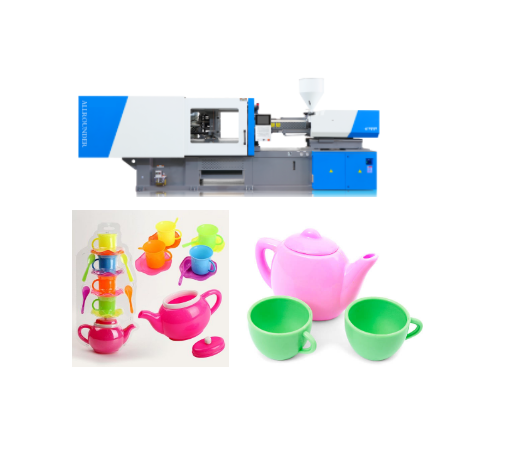
Using injection molding machine for plastic kettles due to its efficiency and cost-effectiveness and economic advantages.
The plastic injection molding machine can produce plastic kettles in bulk. Due to the automated systems, short cycle times, low costs per unit, and high precision. Their high efficiency reduces the total production costs while high productivity ensures the low production cost. Increase the unit ratio, the combination of the two forms core competitiveness.
The core of the economical efficiency of producing plastic kettles with injection molding machines lies in: achieving an exponential reduction in unit costs due to high automation, low scrap rate, the scale effect, and mold reuse. For water bottles that require large-scale and standardized production, injection molding systems greatly improve cost efficiency while maintaining the required quality, substantially increasing profit margins for companies.
The key advantages of injection molding machines for plastic kettles in their high efficiency, complex molding capabilities, cost controllability, and maturity. For water bottles that require large production volumes and complex structures, plastic kettles offer unmatched advantages for quality consistency, adaptability of materials, and automation potential. The reasons for using injection molding technology to manufacture plastic kettles can analyse from multiple factors.
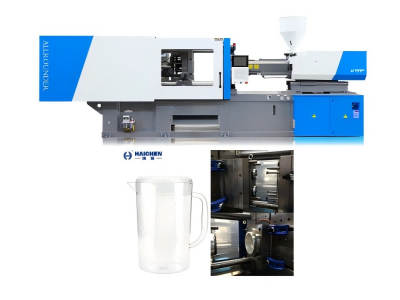
High efficiency and productivity
Injection molding is an efficient production method that can quickly and consistently produce large quantities of plastic parts. For example, injection molding can complete multiple cycles in a short period of time, thereby achieving high output. This characteristic makes injection molding very suitable for large-scale production of plastic water bottles to meet market demand.
Automation and Low Labor Costs
The injection molding process can highly automatic, significantly reducing manual intervention and labor costs, adapting to rapidly changing market demands. Production parameters (such as temperature and mold dimensions) are programmed and the machine operates autonomously and continuously.
Short Cycle Time
The injection molding cycle is short, especially the cooling phase (which accounts for 70% of the cycle time), which can further shorten by optimizing cooling channel design. For example, hot runner systems can speed up cycle times and improve quality consistency, with single cycles taking only seconds to minutes.
Low Waste and Resource Optimization
The process is highly precise, with minimal plastic waste, and it can recycle residual material. Furthermore, the injection molding machine itself is designed to be energy-efficient, such as electric models, which reduce energy consumption.
Mass Production Capability
A single mold can produce a large number of products in a short period of time. For example, it can produce hundreds of plastic parts per hour. Daily production can reach tens of thousands to millions of parts.
Cost Diversification
While mold costs are initially high, the cost per part drops dramatically with mass production. For example, when producing over 100,000 parts, the cost per part is significantly lower than other processes.
Consistency Guarantee
Automated control ensures highly consistent product quality, making it suitable for products requiring stringent specifications, such as kettles.
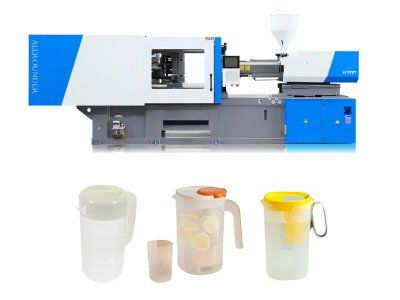
Low cost and economic benefits
Injection molding is an economically efficient manufacturing method that does not require complex equipment or expensive labor. Through automated production lines, it can reduce the labor costs and improve production efficiency. In addition, injection molding also allows the use of low-cost raw materials (such as plastic pellets), further reducing production costs.
Large-scale production significantly reduces unit costs
Injection molding requires an initial mold investment, but subsequent unit production costs are extremely low, making it particularly suitable for large-scale production. Once the mold is complete, the marginal cost per unit decreases significantly. The higher the production volume, the lower the unit cost.
Efficient Automation Reduces Labor Costs
The injection molding process is highly automated, operated by machines and robots, requiring minimal human oversight, significantly reducing labor requirements and associated costs.
High material utilization and reduced waste
The injection molding process minimizes waste by precisely controlling the amount of material injected. Residual plastic can be recycled, further reducing raw material costs.
High-speed production improves economic efficiency
Short injection molding cycles (typically 15-120 seconds per piece) enable production of hundreds of pieces per hour, quickly meeting large-volume order demands and accelerating capital turnover.
Mold Reusability and Design Optimization
Molds can be reused over time (designed for hundreds of thousands of cycles), and optimized designs (such as uniform wall thickness) reduce defects and further reduce costs.
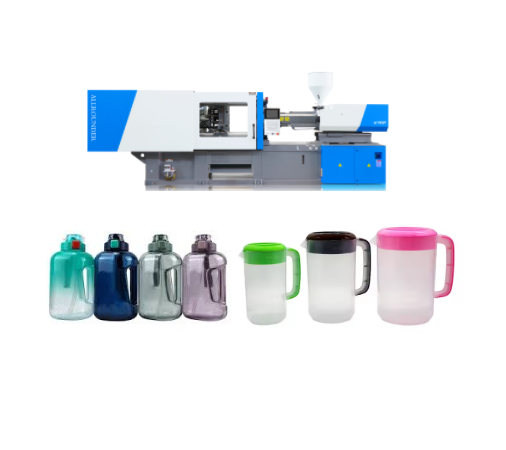
Flexibility and diversity
Injection molding technology has high shape flexibility and can produce various complex and intricate designs. For example, plastic water bottles may require specific shapes or functions (such as handles, lids, etc.), and injection molding can easily achieve these complex designs.
Complex Geometric Shapes
Injection molding machines can produce plastic kettles with complex structures such as thin walls, concave surfaces, and curved surfaces (e.g., handle curvature and spout details), which are difficult to achieve with traditional processes.
High Precision and Consistency
The molds can precisely replicate design details (e.g., scale lines and anti-slip grooves), ensuring minimal dimensional error in high-volume production and meeting the functional requirements of the kettles.
Color and Texture Customization
By adjusting the mold and material, the color, transparency, or surface texture (e.g., matte or glossy) can be quickly switched to meet diverse market aesthetics.
Wide range of materials
Injection molding supports dozens of thermoplastics, including polypropylene (PP), polyethylene (PE), and polycarbonate (PC). You can choose the properties you need for your kettle (e.g., PP for high-temperature resistance, PC for high transparency).
Adjustable performance
By adjusting material density or adding fillers (e.g., glass fiber for enhanced strength), you can achieve both lightweight and drop-resistant kettles.
Strong adaptability
Injection molding technology is flexible and can design complex geometric shapes and multi cavity molds according to requirements. This flexibility enables manufacturers to easily produce plastic kettles that meet different design requirements. In addition, injection molding also supports customized production, and mold and process parameters can be adjusted according to customer needs.
Design Flexibility and Adaptability to Complex Structures
- This injection molding machine can produce products ranging from micro-precision parts to large, complex structures (such as spouts and handles), supporting highly customized designs. Using computer-aided design (CAD/CAM), it can achieve precision tolerances down to 0.001 inches, meeting the structural requirements of various kettle components (such as lid seals and anti-slip textures).
- The closed mold design ensures that the molten plastic can fill complex corners (such as curved kettle bodies and internal ribs), providing maximum design freedom.
Flexible Production Scale
- Equipment sizes range from small to large: small machines are suitable for producing precision spout components, while large machines are suitable for high-volume production of entire teapot bodies.
- Automated systems (robotic arms, temperature control units) enable rapid changeover: a single mold can produce millions of pieces per day, adapting to fluctuating orders.
- Multi-cavity mold technology improves efficiency by enabling simultaneous production of multiple identical or different parts.
Process Compatibility and Cost Adaptability
- High automation reduces labor reliance: A single operator can control the entire process, reducing labor costs.
- A waste recovery system (such as runner material recycling) reduces material loss and meets environmental requirements.
- Although the initial mold investment is high, the unit cost is significantly reduced with large-scale production, making it suitable for large-scale kettle production.
Reduce waste and improve resource utilization
The amount of waste generated during the injection molding process is relatively small, and these waste materials can be recycled, further reducing production costs and minimizing resource waste.
Injection molding technology has become an ideal choice for manufacturing plastic water bottles due to its high precision, short cycle time, material diversity, cost-effectiveness, and strong adaptability. This technology not only meets consumers’ requirements for product quality and appearance, but also maximizes economic benefits in large-scale production.
Precisely control material usage and minimize virgin resource consumption
- Injection molding machines precisely control melt temperature and pressure to ensure uniform plastic material filling the mold, using only the necessary amount of material and significantly reducing waste.
- Traditional processes (such as cutting large pieces of plastic) can generate up to 30% waste, while injection molding can keep waste rates to extremely low (or even near zero).
Waste Recovery and Recycling
- Scrap and defective parts from the injection molding process can be directly shredded and re-entered into production, creating a closed-loop recycling system and reducing reliance on virgin plastic.
- Modern injection molding machines are compatible with recycled plastics (including post-consumer regrind), transforming waste into high-quality products and supporting a circular economy.
Efficient Energy Utilization
New injection molding machines utilize energy-saving technologies (such as servo motors and intelligent temperature control), reducing energy consumption by 20-50% compared to ten years ago and reducing their carbon footprint.
Automated production processes (such as robotic part handling) further reduce energy consumption per unit of product, improving resource efficiency.