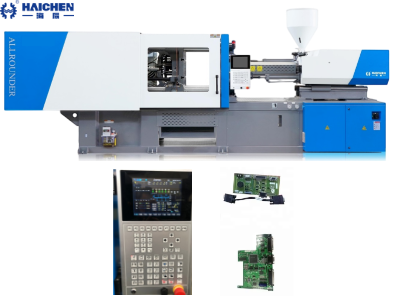
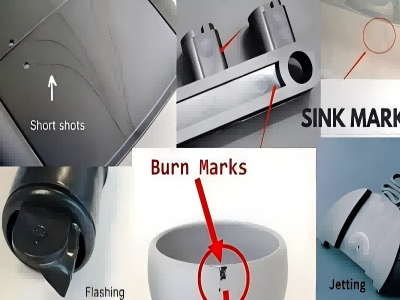
Injection molding defects refer to the undesirable appearance, size, structure, or performance of plastic products caused by factors such as materials, processes, mold design, or operating conditions during the injection molding process. These defects may affect the aesthetics, functionality, and structural integrity of the product.
An injection molding troubleshooting chart is a systematic tool for identifying and solving common problems in the injection molding process. It is usually presented in a table format, listing various defects, their causes, and corresponding solutions. For example, some literature mentions a table that details the defect name, the number of pictures, and possible causes and solutions.These Injection Molding Defects and Troubleshooting not only affect the appearance and performance of the product but may also lead to increased production costs and reduced production efficiency.
In actual production, we will consider factors comprehensively. And then these problems will be solved by adjusting process parameters and optimizing mold design. Therefore, finding out reasons and solutions is the key to improving product quality and production efficiency. In this blog, we will talk about injection molding common troubleshooting definition, reason and solution.
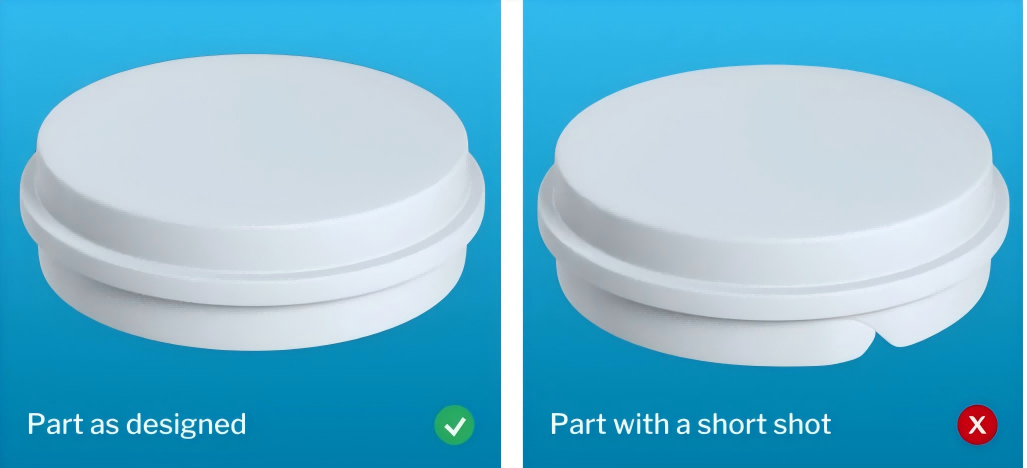
Short Shot
Definition
In injection molding, short shot refers to the failure of molten plastic to completely fill the mold cavity, resulting in some products not being filled or having insufficient size. This type of defect usually manifests as material loss at the end of the mold cavity or in the thin-walled area, affecting the integrity and functionality of the product
Reasons
- Insufficient injection pressure: If the injection pressure is not sufficient, the molten plastic may not be able to reach all areas of the mold cavity, resulting in incomplete filling.
- Low melt temperature: Low temperature will increase the viscosity of the material, making it difficult to flow, resulting in insufficient filling.
- Mold temperature too low: Mold temperature too low can cause plastic to solidify prematurely in the mold, hindering its flow.
- Slow injection speed: Slow injection speed can cause the plastic to cool and solidify in the mold, making it impossible to fully fill.
- Unreasonable mold design, such as improper gate position, unreasonable runner design, and excessive thin-walled areas, can all lead to obstruction of molten plastic flow.
- High material viscosity: High viscosity materials have poor flowability and are difficult to fill complex or thin-walled areas.
Solutions
- Material pretreatment:
Moisture absorbing materials (such as PA) must be dried to a dew point of ≤ -40 ℃. - Variable temperature mold technology:
Filling stage mold temperature → material Tg+50 ℃, cooling stage → Tg-30 ℃, balancing fluidity and cycle. - Process monitoring:
Install a cavity pressure sensor to provide real-time feedback on the filling status (warning if the end pressure is less than 80% of the set value).
Core principle: Short shot is the result of an imbalance of the three elements of fluidity, resistance, and thermodynamics, which needs to be resolved through a coordinated system chain of material selection, mold design, process window, and equipment maintenance
Warpage
Definition
Warping is a geometric deformation of injection molded parts caused by uneven shrinkage, and a dimensional deviation exceeding 0.1% -1.5% is considered a defect
Reason
- Uneven material shrinkage: Differences in shrinkage rates in different directions (such as flow direction and vertical direction) are the main cause of warping. During the cooling process, the material undergoes uneven shrinkage, resulting in internal stress and warping.
- Uneven mold temperature: The temperature difference between the upper and lower surfaces of the mold can lead to different cooling times, resulting in inconsistent residual stresses inside and further exacerbating warping.
- Improper injection pressure and holding pressure: Insufficient injection pressure or too short holding time can cause the material to not be fully filled in the mold, resulting in uneven shrinkage during cooling and causing warping. Properly increasing injection pressure and holding time can help reduce warping.
- Unreasonable mold design: Improper gate position, gate size, cooling system design, and demolding system design can all affect the flow and cooling of materials, leading to warping. For example, a single center gate may cause distortion of flat products, while multiple point gates or film gates can effectively prevent warping.
- Unreasonable product design: Uneven product thickness and unreasonable structural design (such as uneven transitions between thick and thin parts) can also lead to warping. Optimizing product design, such as adding ribs and uniform thickness, can improve dimensional stability.
- Improper cooling system design: Improper cooling system design can lead to uneven cooling, resulting in uneven shrinkage and warping. Optimizing the cooling system to ensure uniform cooling is an important measure to reduce warping.
Solution
- Annealing treatment Condition: The temperature is 10-20 ℃ lower than the material’s thermal deformation temperature (approximately 80-100 ℃ for PC/ABS), and the time is calculated based on a wall thickness of 1h/mm.Mechanism: Molecular chain rearrangement releases residual stress, with a warpage improvement rate greater than 30%.
Attention: Annealing PLA material may cause size changes. - Mechanical Orthopedics
Suitable for mild warping (deformation<2%), fixed by fixture pressure.
Risk: Excessive correction may lead to cracks. - Humidifying treatment
Suitable for moisture absorbing materials (such as PA): Place in an environment of 60-80 ℃/RH60% -80% for 2-4 hours to balance internal stress.
Flash
Definition
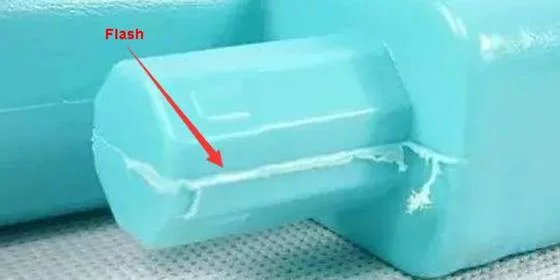
Flash injection molding is a common defect characterized by molten plastic overflowing from the mold parting surface or other gaps when the mold is not tightly closed or under pressure, forming excess plastic layers.
Reason
- Poor mold closure: There are gaps or poor alignment on the parting surface of the mold, causing molten plastic to overflow from the gaps. For example, mold wear, uneven surfaces, or improper design can all lead to burrs.
- Excessive injection pressure: Excessive injection pressure can cause uneven flow of molten plastic in the mold, increasing the risk of burrs. In addition, too fast injection speed may also lead to flying edges.
- Insufficient clamping force: The clamping force is insufficient to counteract the injection pressure, resulting in the mold being unable to fully close and causing burrs. This is usually related to mold wear or clamping system failure.
- Mold temperature too high: High mold temperature will reduce the viscosity of the plastic, making it easier to flow and overflow from the mold. In addition, uneven mold temperature may also lead to burrs.
- Poor material flowability: Low viscosity plastics have poor flowability at high temperatures and are prone to forming burrs in molds. However, high viscosity plastics require higher injection pressure and temperature to fill the mold.
- Mold design defects: such as improper gate position, poor exhaust, or unreasonable mold structure, may all lead to burrs.

flash
Welding Lines
Definition
Injection molding welding line (also known as suture line or knit line) is a defect formed when the molten plastic fluid intersects in the mold. These lines usually appear in areas with holes or obstacles, indicating lower strength in that area.
Reason
- Material flow interruption: When molten plastic encounters obstacles (such as inserts, ribs, etc.) in the mold, the flow is divided, causing the two fluid front ends to reunite in the mold, forming a welding line.
- Temperature difference: The temperature difference of molten plastic in different areas may cause partial solidification, resulting in incomplete fusion and the formation of welding lines.
- Insufficient pressure: Insufficient injection pressure can cause the molten plastic to not fully fuse, forming a welding line.
- Improper mold design: Errors in mold design, such as uneven wall thickness or improper gate position, can also lead to the formation of welding lines.
- Impurities: Impurities in molten plastic may affect flow and lead to the formation of welding lines.
Solution
- Process adjustment:
Raise the temperature of the barrel by 5-10 ℃ and increase the injection speed by 15-20%.
Add local heating (such as ceramic heating plates) on the surface of the fusion zone mold. - Mold modification:
Drilling holes in the fusion zone to increase exhaust
Polish the surface of the fusion zone mold to Ra ≤ 0.1 μ m to reduce flow resistance. - Post treatment: Annealing at 150-180 ℃ for 2 hours to relieve internal stress
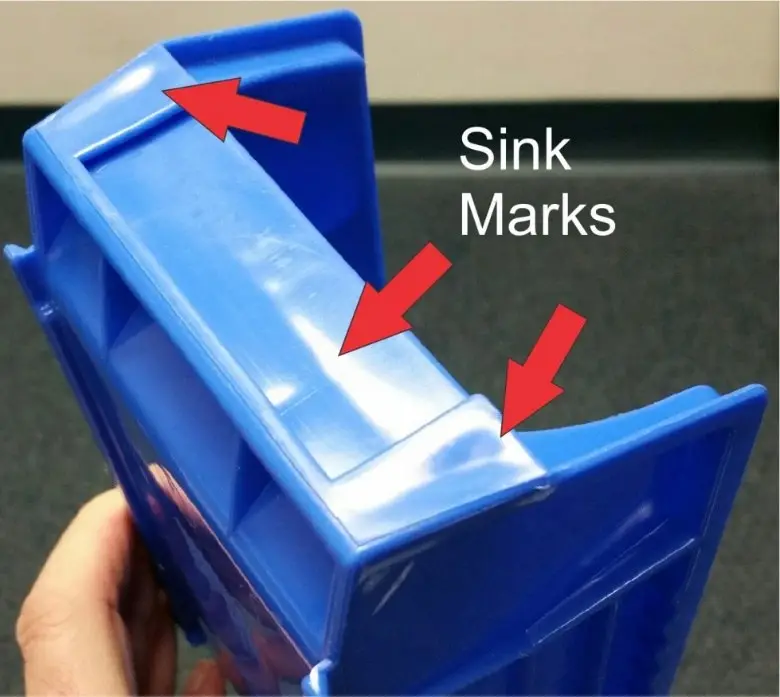
Sink Marks
Definition
Injection molding pits refer to the depressions or grooves that appear on the surface of thicker areas of plastic products, usually manifested as slight depressions or grooves. This type of defect usually occurs in structures such as ribs, protrusions, or internal grids, and is one of the common surface defects in injection molding processes
Reason
- Difference in cooling rate: The cooling rate in thick walled areas is slower, resulting in material shrinkage during the cooling process and the formation of depressions. In contrast, thin-walled areas cool faster and the surface solidifies first, while the contraction of thick walled areas stretches the already solidified surface, forming pits.
- Insufficient filling and holding time: If the filling or holding time is too short, the material cannot fully fill the mold, resulting in uneven cooling of the thick walled area and the formation of pits.
- Improper mold temperature: Excessive or insufficient mold temperature can affect the flow and cooling process of materials, leading to dents. For example, excessive mold temperature may cause premature gate closure, affecting material flow; However, if the temperature is too low, it may cause the material to cool too quickly, resulting in surface defects.
- Improper material selection: Some materials, such as plastics with high filling rates or low melt flow rates, are more prone to producing pits due to their higher viscosity and greater cooling shrinkage.
- Unreasonable mold design: The design of ribs and protrusions is unreasonable, such as ribs being too high or uneven wall thickness, which can lead to uneven cooling and the formation of pits. In addition, improper gate position may also lead to uneven material flow and the formation of pits
Solution
Prevention during the design phase
- Wall thickness optimization
Base wall thickness ≤ 3mm, reinforcement thickness ≤ 0.6T
Convex design: outer diameter=2 x inner diameter
Pouring system:
The gate is located near the thick walled area and adopts a fan-shaped/thin film gate
Channel cross-sectional area>sum of gate cross-sectional areas
Cooling system innovation:
Conform Cooling: Cooling efficiency increased by 40%, cycle shortened by 62% - Material selection and processing
Priority selection: Low shrinkage resin (such as LCP with a shrinkage rate of 0.1-0.3%)
Material pretreatment:
Moisture absorbing materials (PA, etc.) need to be dried at 120 ℃/4h
Adding nano calcium carbonate to reduce shrinkage rate
Through the above analysis, we can see that Injection Molding Defects and Troubleshooting are usually related to factors such as improper process parameter settings, unreasonable mold design, and inappropriate material selection.
Therefore, in actual production, these factors should be considered comprehensively, and these defects should be reduced or eliminated by optimizing process parameters and improving mold design, thereby improving product quality.