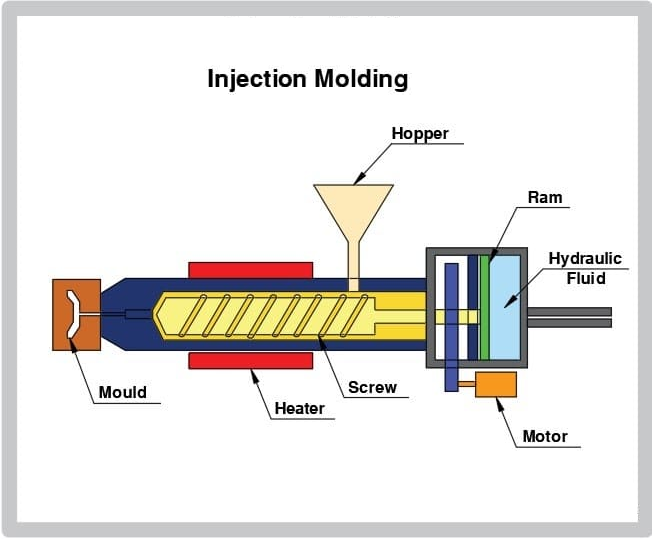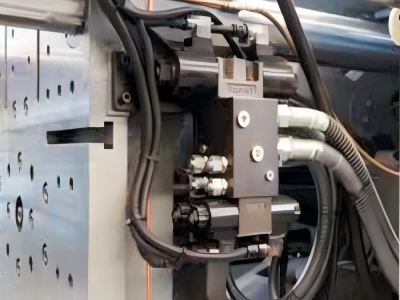
Hydraulic system is the “heart” of injection molding, and its efficient power transmission and precise control ability directly determine the product quality and production efficiency.
Meanwhile,hydraulic systems in injection molding machines amplify and transmit force to move components like the injection unit, mold clamping mechanism, and core pulls.
A hydraulic system, in its most basic form, is a method of transferring force or motion using a pressurized fluid.
It involves a tightly sealed system containing a fluid—typically a type of oil—that’s pressurized by a pump. This fluid is then directed around the system to perform different tasks.
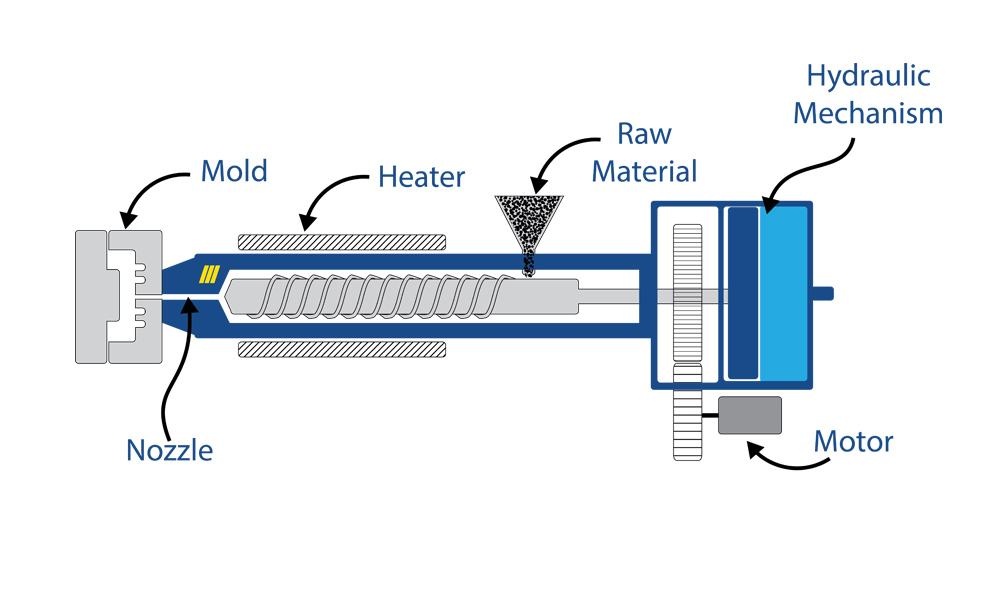
Definition and core role of hydraulic system
In injection molding, the hydraulic system uses the incompressibility of the liquid (Pascal’s law) to transfer energy.
Converting the mechanical energy of the electric motor into hydraulic energy.
And then driving the mechanical action through actuators such as hydraulic cylinders.
- Power output
- Precise control
- Overload protection
Power output
Provide high-pressure power for mold opening and closing, screw propulsion and other actions (pressure range up to 25-80 MPa).
Precise control
The flow rate and pressure are adjusted through proportional valves or servo valves to achieve multi-level control of injection speed and holding pressure.
Overload protection
Integrated safety valve and pressure sensor to prevent damage to system overpressure.
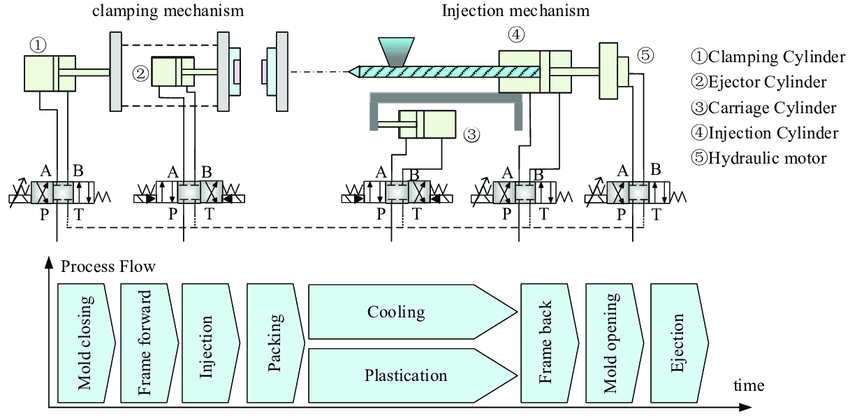
Hydraulic system components & key Components
- Hydraulic Pump
- Hydraulic Actuator
- Control Element
- Auxiliary Devices
Hydraulic Pump (Power Source)
Gear pump: simple structure, suitable for low-pressure scenarios (such as small injection molding machines).
Piston pump: high pressure and high flow, which can meet the needs of large injection molding machines.
Function: Convert mechanical energy into hydraulic energy, output stable oil pressure.
Hydraulic Actuator
Cylinder: drive the mold opening and closing and ejection mechanism, and the response speed can reach milliseconds.
Hydraulic motor: drive the screw to rotate the plasticized raw material, and the torque output is continuously adjustable.
Control Element
Reversing Valve: Changing the direction of the oil flow to switch the action (e.g. mold opening/closing).
Proportional valve: stepless adjustment of flow and pressure through electrical signals to improve process accuracy.
Relief valve: Limits the maximum pressure of the system for safety.
Auxiliary Devices
Oil tank: Stores and dissipates heat, equipped with oil filter and cooler to maintain stable oil temperature (optimal operating temperature: 40-60°C).
Accumulators: Stores pressure energy to cope with transient high-pressure demands (e.g., fast clamping).
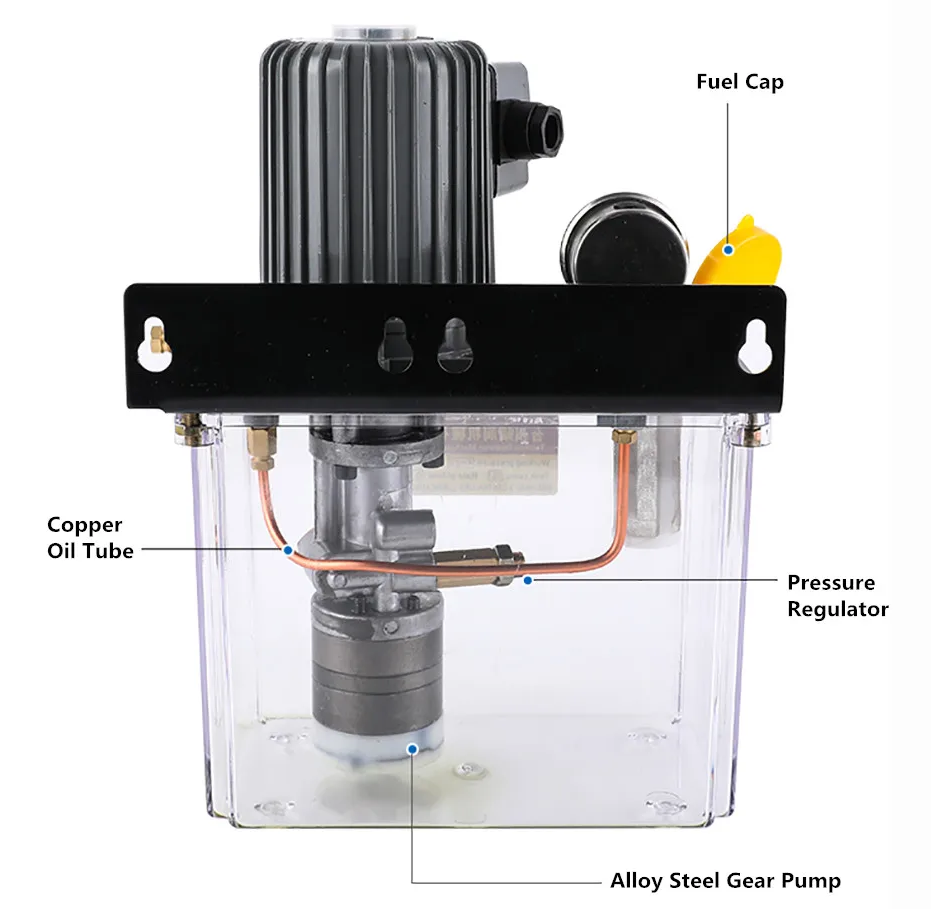
Hydraulic system workflow & energy transfer
- Filling Phase
- Working stage
- Oil return stage
- Shutdown phase
Filling Phase
The hydraulic pump draws oil from the tank and pressurizes it, establishing the system pressure.
Working stage
The high-pressure oil enters the hydraulic cylinder through the control valve.
And the piston is pushed to complete the mold closing, injection and other actions.
Oil return stage
After the action is completed, the oil returns to the oil tank through the circuit to reduce the system pressure.
Shutdown phase
The valve closes and the system goes into standby.
Energy Transfer Path: Electric Motor → Hydraulic Pump (Mechanical Energy→ Hydraulic Energy) → Control Valve (Distribution Energy) → Hydraulic Cylinder (Hydraulic Energy→ Mechanical Energy) → Load (Mold/Screw).
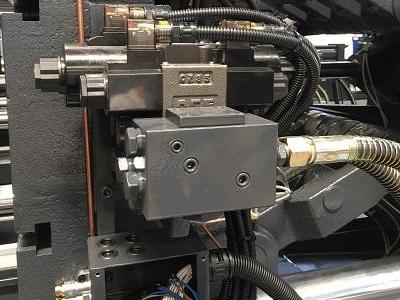
Advantages of hydraulic system
Hydraulics offer the following unique advantages in injection molding machines compared to mechanical or electric systems.
- High power density
- Stepless speed regulation
- Fast response and high stability
- Safety & Adaptability
High power density
More power per unit volume is suitable for high-load scenarios (e.g., large molds with clamping forces of thousands of tons).
Stepless speed regulation
By adjusting the flow valve or proportional valve.
the speed of the actuator can be smoothly adjusted to adapt to different process needs.
Fast response and high stability
The incompressibility of the hydraulic oil ensures fast and precise action, making it suitable for high-speed injection cycles.
Safety & Adaptability
Overload protection function prevents equipment damage.
By adjusting the parameters, it can be compatible with different materials and molds.