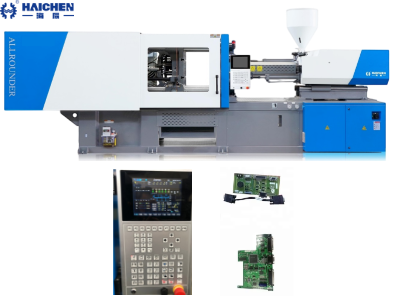
The reason why injection molding machines need to use different screws is mainly because different types of plastic materials have different physical and chemical properties.
Different materials require different processing methods.
For instance, thermoplastics and thermosetting plastics have different melting properties, so different types of screws are needed.
For example, special screws are used for processing special plastics, such as thermosetting plastics and polyvinyl chloride.
In addition, the structural parameters of the screw are also very important, such as the length-to-diameter ratio, compression ratio, and the proportion of each section’s length, etc.
It has been mentioned that the difference in length-to-diameter ratios will affect the plasticizing ability and production efficiency.
Screws with a large length-to-diameter ratio are suitable for materials that require thorough plasticization, while smaller ones may be suitable for high-speed production.
There is also the design of the compression section.
The gradient type and the sudden change type are suitable for different materials, such as amorphous and crystalline plastics.
Meanwhile, different plastics have different viscosities and melting points, and thus require different shear and thermal conductivity properties.
For instance, PVC requires a lower shear to avoid decomposition, while polyolefins may need a higher shear.
Therefore, the screw design needs to adjust the depth of the screw groove and the thread structure to adapt to these characteristics.
The application scenarios require different types of screws.
Special designs can handle specific processing requirements, such as preventing fiber breakage or improving the mixing effect.
In addition, the material of the screw is also very important. Different materials and surface treatments, corrosion resistance and wear resistance are discussed.
For example, special coatings or materials are required when dealing with corrosive materials.
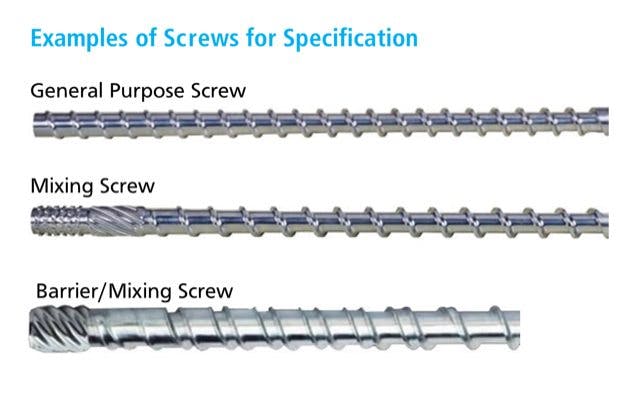
The detailed reasons why are different screws used
Differences in plastic properties
Different plastic materials have significant differences in melting speed.
Heat absorption during melting, melt viscosity, water absorption, thermal stability, etc.
For example, high-viscosity amorphous plastics such as polyvinyl chloride (PVC) require the use of gradient screws that provide a gentler energy conversion to accommodate their wide range of softening temperatures.
Crystalline plastics such as polyolefin (PP), on the other hand, are suitable for the use of mutant screws.
Which have a short compression section and a sharp energy conversion that facilitates rapid plasticizing.
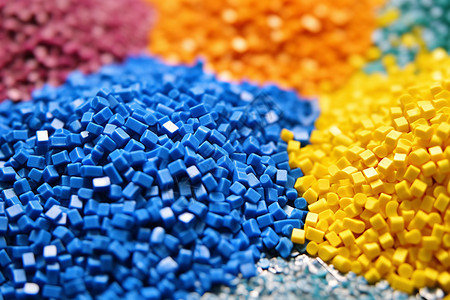
Process requirements
According to the fluidity, plasticization requirements, filling rate.
And mixing effect of the plastic, the appropriate screw type needs to be selected.
For example, general-purpose screws are suitable for most low- and medium-viscosity thermoplastics.
While special screws are used to process plastics or articles with special requirements.
The function of the screw
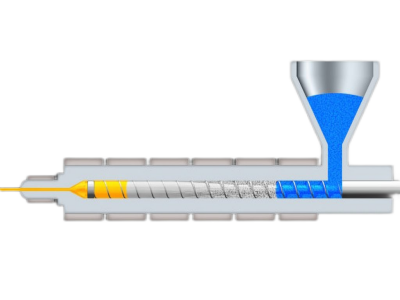
The screw is not only a tool for transporting plastics, but also responsible for processes such as melting, compaction, mixing, and pressurization.
Therefore, different types of screws also have different designs for these functions.
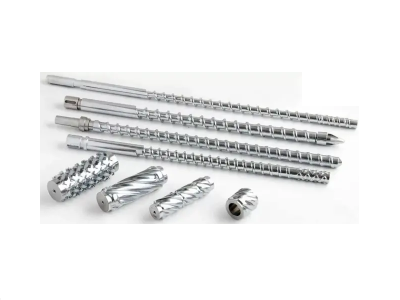
For example, the split screw has a secondary thread in the compression section, which improves the plasticizing effect and repeatability.
Product performance requirements
For some products with special requirements for product quality,
such as LED lamp accessories or heat dissipation devices with high light transmittance,
ordinary screws may not be able to meet their high-quality production needs.
Therefore, special screws are required to ensure product performance.
Technical complexity
The design and manufacture of screws is highly technical and requires a custom design based on the specific characteristics and operating conditions of the plastic.
This includes consideration of technical indicators such as hardness, toughness, wear resistance, and corrosion resistance.
Therefore, injection molding machines need to use different screws to ensure that they can efficiently handle a wide range of plastic materials and meet the requirements of different processes and product properties.
Design considerations for injection molding screws
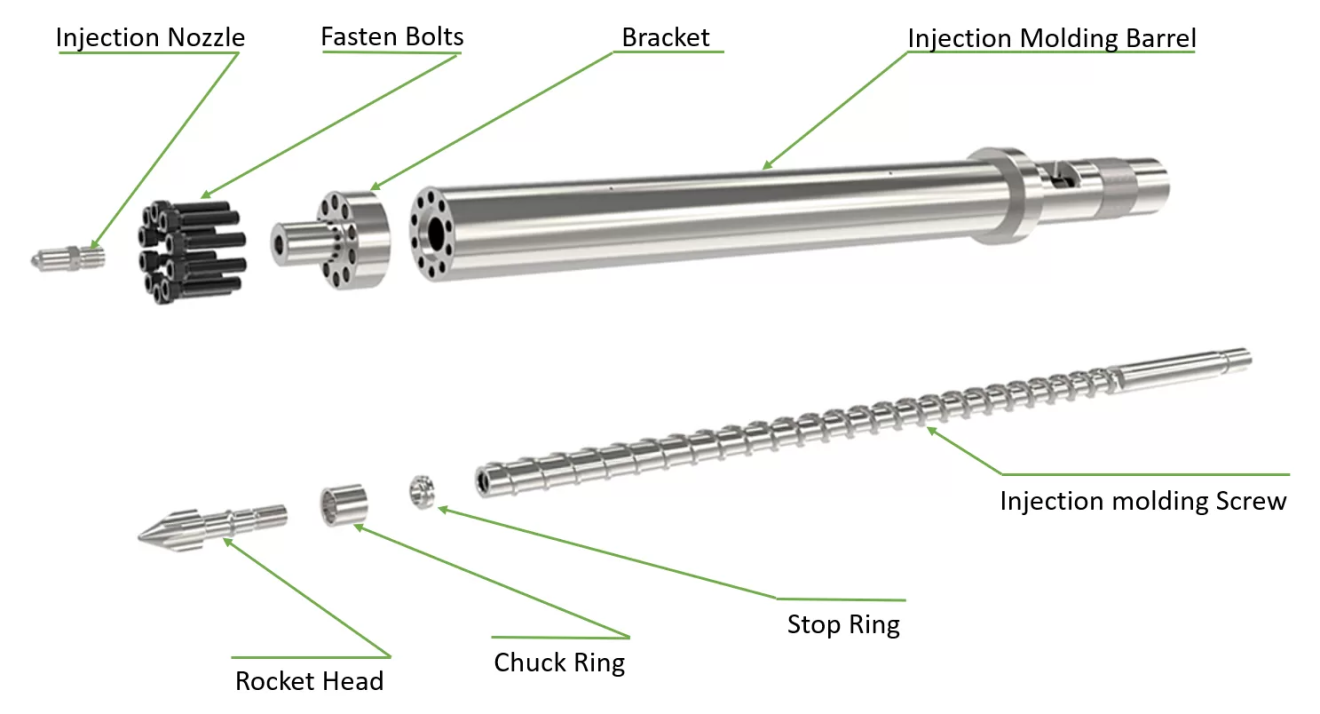
The overall surface of the three small parts of the screw head must be smooth.
Except for the assembly part, there should be no right angles or sharp corners visible on the front.
Moreover, they will accumulate materials, making the raw material flow less smooth. After long-term use, black spots and yellowing may occur.
The design of both ends of the rubber ring is also particularly important.
First, there is flat contact without inclined contact. If the surface is large, the service life will be much shorter than that of an inclined surface.
Secondly, the contact surface between the meshes without a bevel and the screw head will become a dead corner.
If the raw materials stay for a long time, black spots and yellowing may occur.
This slope is best at 30 degrees. 15 degrees is not large enough and is prone to material accumulation.
The 45-degree contact surface is large and it is less likely to accumulate materials, but it is easy to break the rubber ring when injecting glue.
The left and right movement clearance of the rubber ring should be moderate.
Depending on the raw materials used in production, the movement clearance should be large or small.
The surface hardness of the threaded part of the screw head does not have to be as high as that of other parts.
Excessive hardness can easily lead to thread detachment and reduce the strength of the thread.
The threaded part should undergo tool withdrawal treatment.
In this way, the stress distribution is more uniform.
Injection molding machine screw function
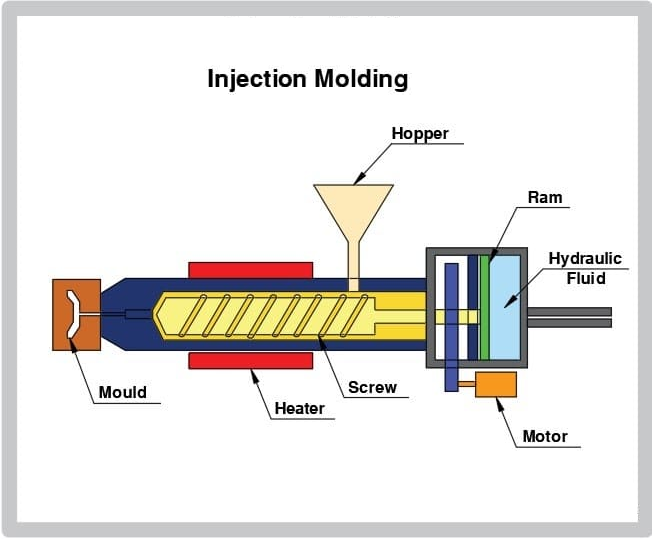
The injection molding machine screw is one of the core components of the injection molding machine.
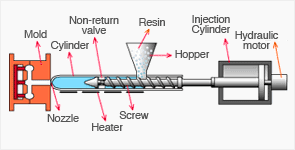
Its main function is to convey, compact, melt, stir, and apply pressure to the plastic, these processes are completed by the rotation of the screw in the barrel.
Screws are typically made up of tapered spirals, and their design and selection are critical to the performance and productivity of an injection molding machine.
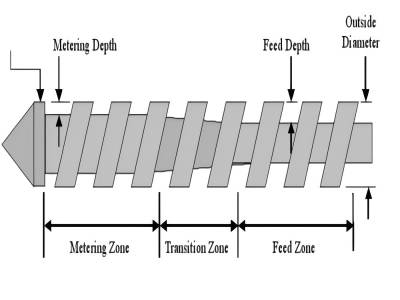
The screw is generally divided into three main sections: the feeding section, the compression section, and the homogenization section (metering section).
The feed section is mainly used to transport the raw materials to the back section, the compression section is responsible for the melting, mixing.
And compression of the plastic raw materials.
And the homogenization section is responsible for the conveying and metering of the melt.
Different types of screws are suitable for different plastic materials and process requirements.
For example, gradient screws are suitable for high-viscosity amorphous plastics, such as polyvinyl chloride, etc.
When choosing an injection molding machine screw, you need to consider factors such as the material of the screw.
The segmentation design, the parameters, and the type of plastic that is applicable.
In addition, the design of the screw should also take into account its friction characteristics with the plastic to avoid contamination during the plasticizing process.
In short, the design and use of injection molding machine screws directly affect the quality and production efficiency of plastic products,
so a variety of factors need to be considered in the process of purchase and use to ensure the best plasticizing effect and product quality.
The type of screw that Haichen can provide
Imported high-alloy steel fully hardened screw
This screw can effectively withstand high temperature, high torque, high-pressure impact,
wear resistance, corrosion resistance, and smooth surface without pores to reduce surface adhesion and degradation.
Screws made of this material are suitable for applications that require high wear and corrosion resistance.
Stainless steel or double alloy nickel-plated screws
Screws made of this material are suitable for the addition of toner to plastics and need to be customized to strengthen the color-mixing type screw.
UPVC special screw
In view of the characteristics of high viscosity, easy decomposition, strong corrosiveness,
and good plasticization of PVC pipe joints, this kind of screw has good plasticization, less shear heat, and acid corrosion resistance.
PC special screw
For PC and other high-viscosity plastics, less shear heat, acid corrosion resistance,
medium and small diameter, molding PC, PP-R, flame retardant ABS, and other effects are good.
The use of different screws is to optimize equipment performance, improve processing efficiency, and meet specific process requirements.
This diverse selection enables screws to play a critical role in various industrial applications.
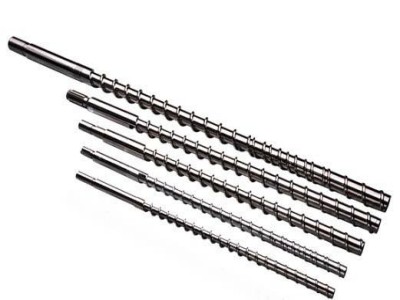
Haichen provides wear protection for the screw
Haichen produces screws made of various steels. We can add surface treatments, such as gas or nitride ions, or hard chromium plates, to provide additional surface protection.
With our professional knowledge and experience, we specifically design screws to enhance the efficiency of your production process and applications.