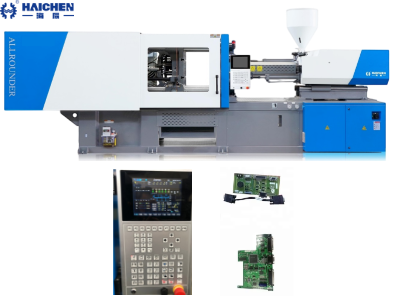
When we receive the new die casting machine, we will install the machine and test run the die casting machine first time. There are some details and steps that need to be learned before the machine starts.
After purchasing the cold chamber die casting machine, please read our instruction manual seriously, it can make you have a better and quick underestimating of our cold chamber die casting machine structure, performance, and adjustment, so as to do machine installation and put it into use smoothly.
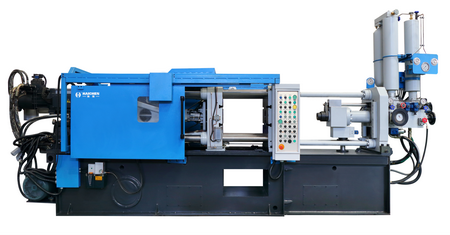
How to run a die casting machine for the first time?
Here we will explain 7 steps to start the new die casting machine:
- Before test run of die casting machine.
- Check the machine after installation.
- Check the machine parts
- Remover the three oil tank covers
- Fill 46# antiwear hydraulic oil.
- Adjusting the mold thickness.
- Injection without material
Before test run
Understand the hydraulic and electrical principles, machine structure and performance, operating and adjusting methods, safety, and protection of the instruction fully.
After installation
Clean the machine, wipe off rust-proof oil and dust, especially the movable parts, for example: four tie bars, the bearing block at the bottom of the second platen, and the rail, and re-lubricate if necessary. Lubricate rust-proof oil on the exposed metal part of the machine.
Check parts
Mechanical parts, electrical parts, the oil circuit, especially mechanical safety parts, key parts, plugs, short circuit and open circuit of lines, and connection of the oil circuit.
Remove the three oil tank covers
If necessary and clean the oil tanks, fill the working hydraulic oil in the air cleaner at the mould closing seat.
When filling oil, remove the top cover of the air cleaner, and fill about 500L of clean flame retardant hydraulic oil.
The oil level in the tank should be a little bit higher than the middle of the level meter. Never use common hydraulic oil to avoid burning.
We recommend you adopt 46# or 68# antiwear hydraulic oil.
Fill 46# antiwear hydraulic oil
In the central lubrication station, operate several times manually to feed oil to each oil site. Keep filled oil cleaning.
Switch on (Three-phase AC 380V, 50Hz), supply cooling water, and open the drain pipeline (0.4MPa). Guarantee good earthing of the machine.
Charge nitrogen in the piston accumulator gas cylinder to 6~8MPa. Attention: The pressure vessel is only applicable for nitrogen. Or the manufacturer will not bear the responsibility.
Before the test run, mount the die casting mould or substitutive die cushion, only slow injection is available for testing of empty injection. If the fast injection is going to be tested, a soft pad must be placed in the injection chamber to protect the machine. Do not test too much.
Inch the oil pump for the rotary direction of the motor. Change phases if necessary.
A new machine has been tested fully before delivery. The user can perform a test run, operate all relative buttons adjust switches, etc., but it is necessary for delicate operation, to re-adjust any abnormity.
First, check the fuel pump. The maximum pressure is 14MPa and the pressure rated is 14MPa. Controlled by double proportional valves, the minimum pressure of this system is 3MPa.
When the pressure of the hydraulic system is normal, test each procedure of the machine, adjust the work system “manually” to test injection, injection back, die closing, die opening, ejecting, ejecting back, and so on, and then test the automatic working system.
If any fault is found during testing, check the relay and hydraulic solenoid valve, if the electrical part works normally, check the relative solenoid valve for mechanical jamming or other hydraulic fault.
Adjusting the mold thickness: Mount the front second platen and the first platen opening, viz. confirmation of locking force
Measure the mounted die thickness l, the opening L between the second platen and the first platen for Max. die sinking.
Perform coarse adjustment of the opening L between the second platen and the first platen, make it less than mold thickness, and l-L=1.7 0 -0.7.
Make test die closing, if the toggle can straighten by the end of die closing, the locking force adjustment is available. The machine can be used for the test run, so fine-adjust the opening according to the requirement of processing.
Injection test without material
After adjusting the right mold size, we can start to inject the piston without the material loading.
The first injection also can remove the position or chamber from die casting machine for safety.
Several problems for confirmation of reasonable locking force.
Adjustment of the opening must be in the state of the die opening to meet the requirement of interlocking and safety of the test run.
If the toggle cannot straighten, increase the opening till the crosshead can straighten smoothly, but an oversize opening may cause a lack of locking force, and then burr on die casts.
The locking force for die casting is not “the bigger, the better”, such as reaching the rated locking force of 1800kN. In contrast, the locking force needs to be reduced properly to improve the quality of the die-cast for better exhaust of the die and prolong the service life of the machine at the same time.
Mold adjusting depends on the turning scale of the small gear, 0.066 per scale mark. A dedicated opening display is available for cold chamber die casting machine.
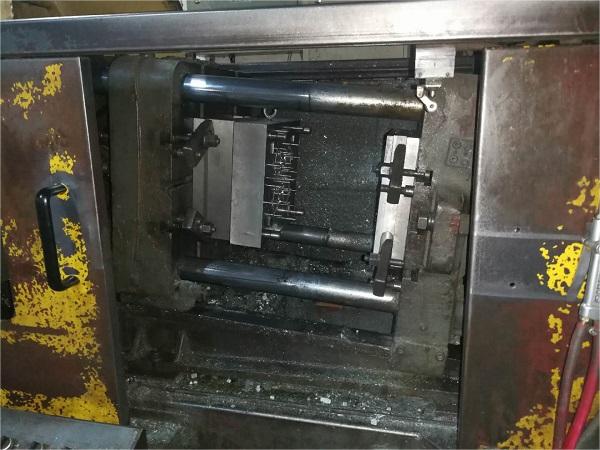
After a period of production, the die will become thermal expansion, and the value of l-L increases, so the actual locking force will exceed the setting, pay special attention to this problem during production.
Fine, adjust the opening to reduce the locking force to meet the requirement of production. During the design of the die-casting mould, safety and reliability should be considered.
Master the technical specification of the die-casting machine, bring into play its capacity, select installing dimensions with accuracy, calculate the total thickness of the mould, and check the Max.
The Min. die thickness, determines the dimensions of the injection unit and all parts, determines the position and sizes of the push rod, the release link, and so on, and checks the injecting travel, pre-resetting unit, and dimension.
In addition, consider avoiding adhesion among several die casts, between the die cast and the ejector pin, rupture at the gate and part die cast remaining on the die.
Avoid faults and minimize hazards to the operator during production. The two die halves should be fixed on the stationary half and moveable half seats firmly.
A die-casting machine should use water-soluble die lubricant. If any oleaginous die lubricant is used, pay attention to fire protection. This machine uses water-soluble lubricant.
Since water-soluble lubricant can be dispersed over water in fine particles, the release agent has very good stability and water dilution, which can form a uniform membrane on the die surface to bear high temperature and high-pressure impact during die-casting, thereby guaranteeing good ingot stripping.
Eccentric die-casting – adjustment of injection cylinder center height
Refer to the structure chart of the injection system, to meet the requirement of eccentric die-casting, move the lifting cylinder up and down to adjust the injection cylinder center height.
Loose the 12 M16 hexagon socket head cap screws in the 2 injection support guide strips before adjustment of the injection cylinder center, but do not touch the other 4 limit screws.
There are three adjustable positions, 0, 70, and 140. The machine has been adjusted before delivery to match the relative chamber seat, spacer (position 0), and height pad (position 70, 140), when the injection cylinder reaches 5~20mm above the required height, insert the relative spacer or height pad, and drop the injection cylinder slowly to it, lock the 12 M16 hexagon socket head cap screws in the two injection support guide strips.
For the horizontal position of the injection plunger (injection cylinder), adjust the three injection supports and the stay bar of the first platen.
After the machine has been installed and adjusted, before regular production you should check the safety protection device carefully.
Check if the guard gate has been connected to all travel switches well if the Emergency Stop button is valid, and if the two-hand Die-button is sensitive.
Only if the safety protection device is in good condition and can work well, regular production is allowed to start.
During production, it is prohibited to detach the guard gate from the machine or make it stop working. Without permission, it is prohibited to modify or replace the guard gate.
Only by carefully studying the operating manual before using the die casting machine can we ensure that there are no accidents in the production process to the greatest extent, and Hichain’s engineers can provide you with the most detailed answers and assistance in this regard.
Conclusion
HAICHEN cold chamber die casting machine has adopted advanced hydraulic components from the USA and Germany, and is equipped with a specially designed industrial control system, which can ensure our machine with high speed, short cycle time, easy operation, stability, safety, and reliability.
If you have any problem during operation, please feel free to contact us for support, we are committed to solving all problems and provide the best service for you as soon as we can.
Thank you for choosing and buying our HAICHEN cold chamber die casting machine. Sincerely hope that our die casting machines bring you with good harvest and high development.
[/vc_column_text][/vc_column][/vc_row]