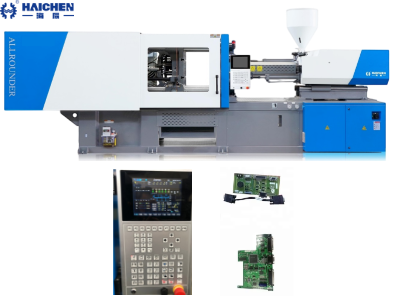
Injection molding cooling systems significance includes improve product quality, shorten production cycle time and so on.
The injection mold cooling system is a key link to ensure molding quality and production efficiency. By optimizing the design of cooling channels, adopting advanced cooling technology, and combining simulation and experimental methods, the cooling efficiency can be significantly improved, the molding cycle can be shortened, and the product quality can be improved, thereby enhancing the competitiveness of the enterprise.
The importance of cooling system in injection molding machine reflects in improving production efficiency, improving product quality, optimizing heat transfer and curing process, reducing defects and costs, promoting technological innovation and reducing environmental impact. The comprehensive performance and economic benefits of injection molding can be significantly improved through reasonable design and optimization of cooling system.
Injection molding cooling systems significance reflectes in many aspects. Including improving product quality, shortening production cycle time and reducing production costs. The following is a detailed analysis:
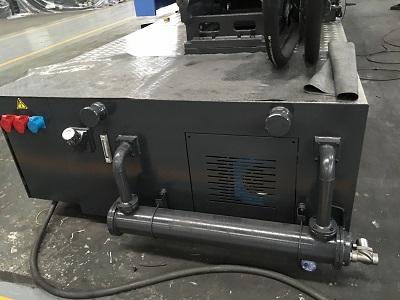
Improve product quality of injection molding cooling systems significance
- Controlling mold temperature
- Shorten the molding cycle
- Improve product quality
During the injection molding process, the design of the cooling system directly affects the quality of the final product. The cooling system controls the mold temperature. It ensure that the plastic melt solidifies evenly in the mold. Thereby reducing defects such as warping, uneven shrinkage, and stress concentration.
In addition, the optimized design of the cooling system can also improve the mechanical properties and dimensional accuracy of the product.
Controlling mold temperature
The cooling system controls the mold temperature to ensure that the plastic solidifies evenly in the mold, thereby reducing problems such as warping, shrinkage, and residual stress. For example, uneven mold temperature can cause dimensional deviations and surface defects in the product, while optimizing the cooling system can achieve uniform distribution of mold surface temperature, thereby improving the dimensional stability of the product.
Shorten the molding cycle
Cooling time accounts for the largest part of the entire molding cycle, usually more than 50% to 80%. By optimizing the design of the cooling system, such as using conformal cooling channels and high-efficiency cooling materials, the cooling time can be significantly shortened, thereby improving production efficiency and reducing production costs.
Improve product quality
The design of the cooling system directly affects the quality of the product, including surface finish and internal defects. For example, if the cooling system is not designed properly, it may lead to insufficient local cooling, which may cause hot spots and residual stress, and then cause product warping and deformation.
By optimizing the cooling system, such as using efficient cooling materials and optimizing the layout of cooling channels, the surface quality of the product can be significantly improved, warping and shrinkage can be reduced, and the overall quality of the product can be improved.
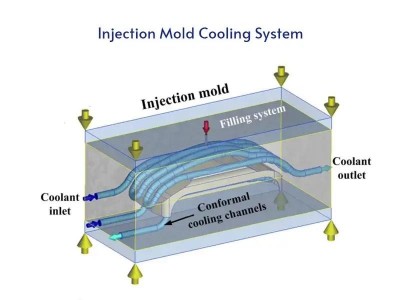
Shorten production cycle time
The cooling system can quickly and effectively remove heat from the mold, allowing the plastic material to cool and solidify quickly. Thereby shortening the molding cycle.
For example, by optimizing the cooling channel design, such as using conformal cooling technology, the heat transfer efficiency can be significantly improved, the cooling time can be shortened, and the problem of uneven temperature can be reduced, thereby improving production efficiency.
In addition, the optimized design of the cooling system can also reduce the heat load of the mold, further shortening the production cycle time.
Shorten cycle times
The efficient cooling system directly reduces cooling time by optimizing the cooling channel design:
Reduce production costs of injection molding cooling systems significance
Shortening cycle time directly increases output per unit time and reduces unit cost.
Improve production efficiency
From an economic perspective, shorter cooling times mean higher production efficiency. Allowing manufacturers to produce more products in a shorter time, thereby reducing production costs and increasing profitability.
By optimizing the cooling system, the cooling time can significantly shorten, thereby improving production efficiency. For example, using a conformal cooling system can reduce the cooling time by up to 62%, thereby greatly increasing production speed.
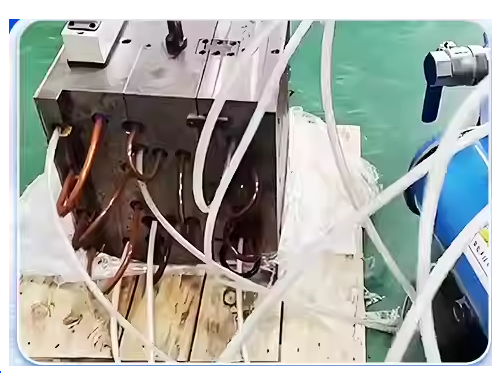
Reduced production costs
- Reduced energy consumption
- Reduce scrap rate
- Reduce maintenance costs
Reduced energy consumption
The optimization of the cooling system not only improves production efficiency, but also reduces energy consumption. For example, the use of equipment such as cooling towers can reduce the energy consumption required for cooling, thereby reducing overall operating costs.
In addition, an efficient cooling system can reduce heat accumulation in the mold and extend the mold life, thereby reducing the cost of replacing the mold.
Injection molding cooling systems significance: Reduce scrap rate
Because uneven cooling can cause problems such as warping, shrinkage and deformation of plastic products, optimizing the cooling system can reduce these defects and thus reduce scrap rate. For example, using conformal cooling technology can ensure uniform temperature distribution in the mold, reduce warping and shrinkage problems, and improve product quality.
In addition, the design of the cooling system in injection system can also reduce defects caused by premature solidification, such as welds, flow marks, etc.
Reduce maintenance costs
By optimizing the cooling system design, the wear and thermal stress of the mold can be reduced, thereby extending the service life of the mold and reducing maintenance costs. For example, the use of cooling towers can reduce the operating pressure of the cooling system and reduce maintenance costs.
Production costs can significantly reduce by shortening production cycle time. In addition, the optimized design of the cooling system can also reduce material waste and improve mold life. For example, studies have found that the use of a conformal cooling system can reduce material waste and extend the life of the mold due to more uniform mold temperature.
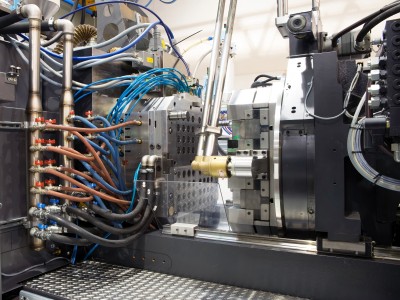
Technical Challenges and Solutions
Although the design of the cooling system is crucial, its design process is complex and requires precise calculations and simulations. Traditional cooling channel designs usually use straight-through holes or radial holes, which often fail to provide uniform temperature distribution, resulting in low cooling efficiency.
In order to solve these problems, a variety of advanced cooling system design methods have been developed in recent years, such as using additive manufacturing technology to create conformal cooling channels (AM-CCC), which can customize cooling channels according to mold geometry, thereby improving cooling efficiency and product quality.
Uniformity Control Challenges
- Complex geometries (such as automotive parts and medical devices) are prone to localized overheating or overcooling, leading to uneven shrinkage.
- Differential mold material thermal conductivity (e.g., aluminum vs. steel) exacerbates uneven temperature distribution.
Cooling Efficiency Bottlenecks
- Plastics have poor thermal conductivity (0.1–1.8 W/m·K), resulting in slow cooling of thick-walled parts.
- Traditional linear cooling channels are difficult to fit into complex cavities, resulting in low heat exchange efficiency.
The design and optimization of the injection molding cooling system is a complex but critical process that requires comprehensive consideration of mold design, cooling technology, material selection and production requirements. By adopting advanced design methods, optimization tools and new technologies, production efficiency and product quality can be significantly improved while reducing production costs and environmental impact.
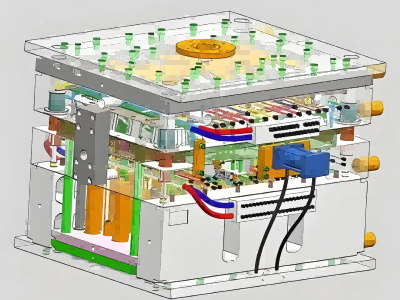
Practical Applications and Case Studies
Multiple studies and experiments have verified the impact of cooling system optimization on actual production.
For example, in one study, by optimizing the cooling system design, the cooling time successfully reduced from 20 seconds to 14.02 seconds. And the warpage was reduced from 34% to 9.62%, significantly improving production efficiency and product quality.
In addition, molds using a conformal cooling system showed better temperature uniformity and lower warpage in actual production.
Thus, the importance of cooling system in injection molding is not only reflected in improving product quality and shortening production cycle time, but also in its contribution to reducing production costs. By adopting advanced cooling system design methods, such as conformal cooling channels and additive manufacturing technology, the overall performance and economic benefits of injection molding can be significantly improved.